October 25, 2026
White Label Marketing Services: Models and Margins
You land a good client. Then they ask for outbound lead generation, a service you don't staff, don't want to fake, and can't hire for profitably on one account. Saying no stings. Saying yes badly stings more.
Table of Contents
- What White Label Marketing Services Really Mean
- Engagement Models and Who Carries the Risk
- Margin Math Agencies Can Actually Run
- Who Owns the Client When the Work Goes Wrong
- Deliverability and Compliance You Inherit
- How to Choose a White Label Partner
- Run a Pilot Before You Sign Anything
What White Label Marketing Services Really Mean
A client sits across from you on Zoom and says the words that ruin Tuesdays. "Can you also handle outbound?" You've got strategists and designers. You've got nobody who should be warmup-testing mailboxes at midnight.
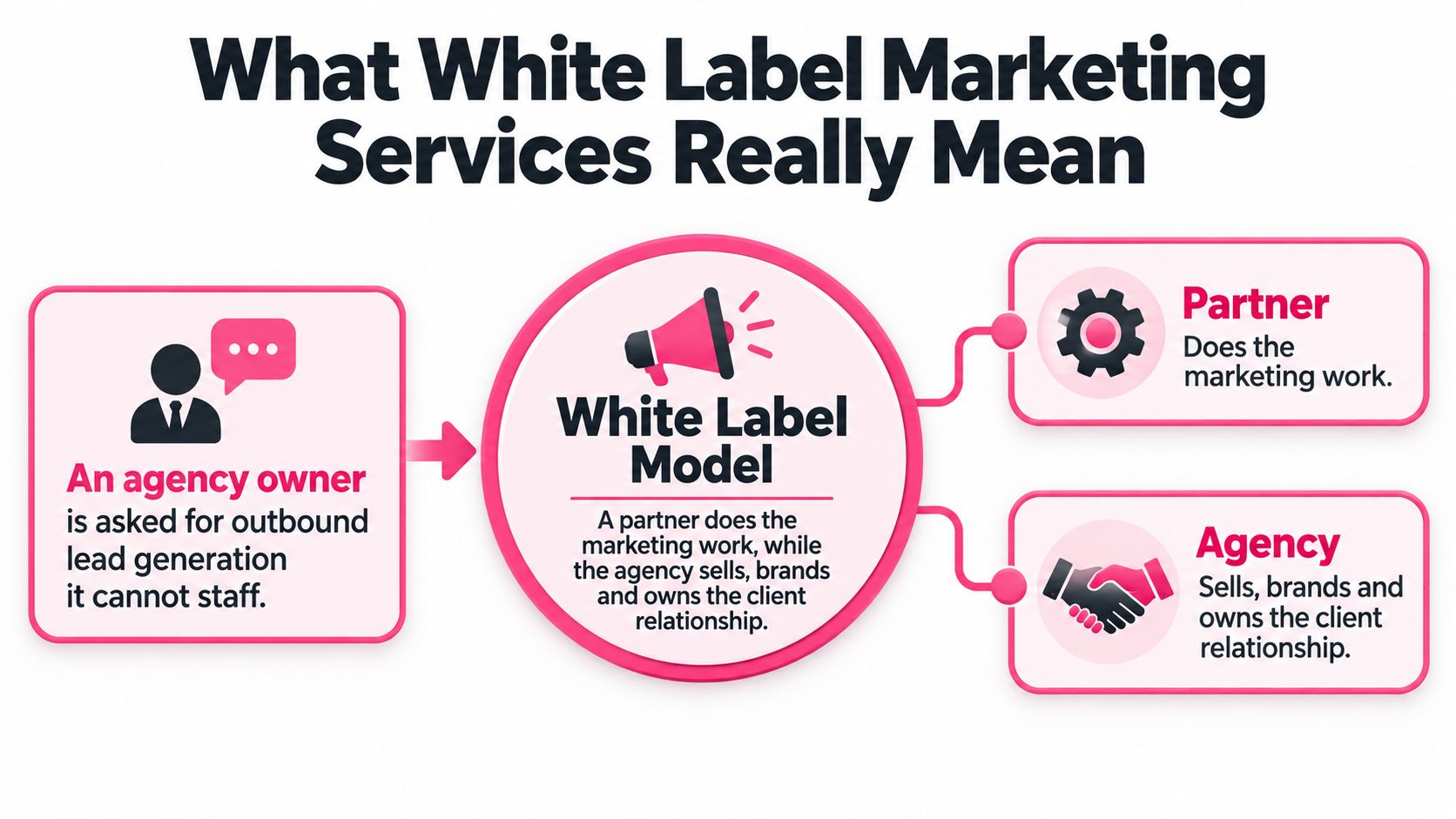
White label marketing services means a partner does the marketing work, while your agency sells, brands and manages it under its own name.
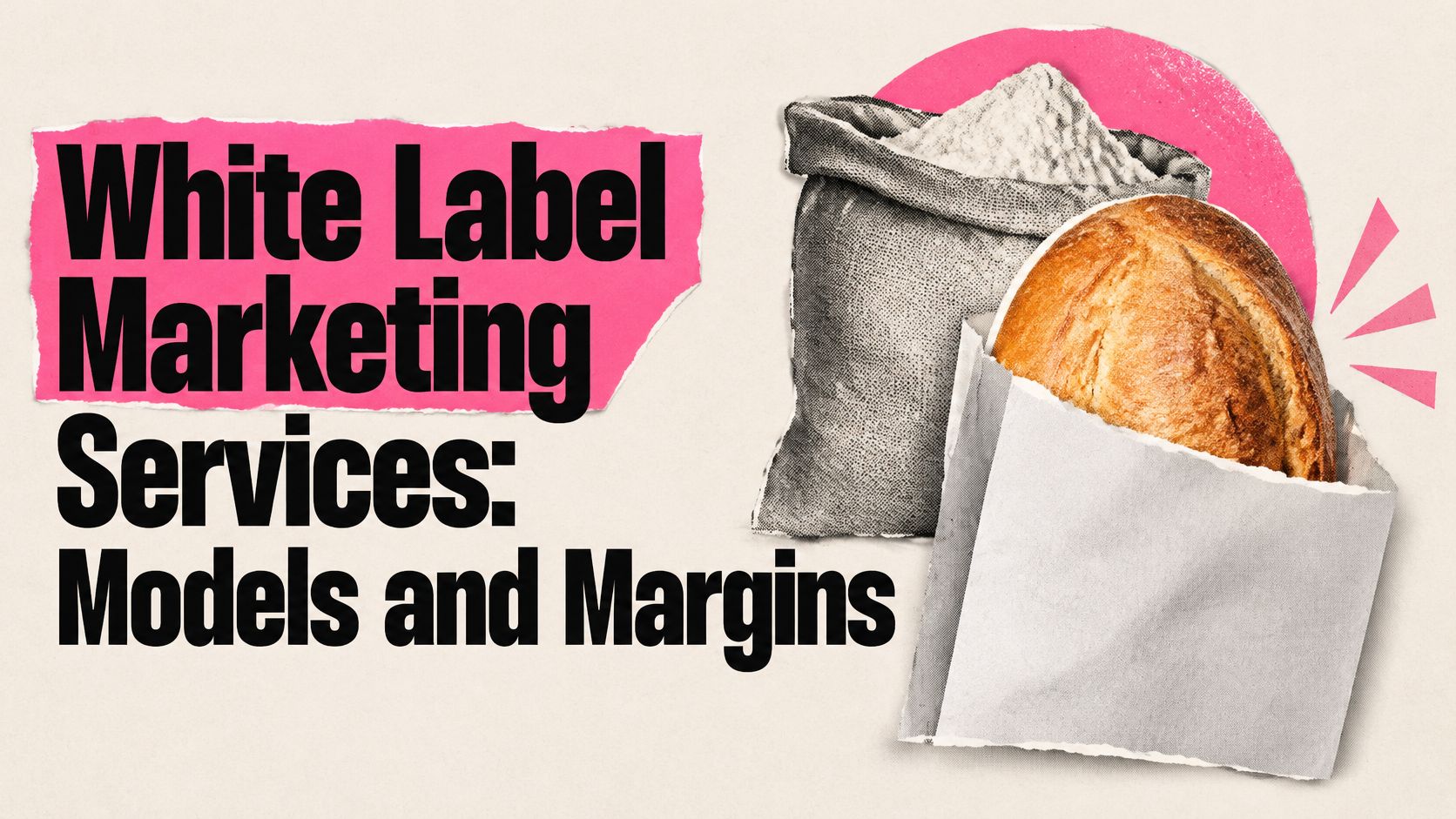
Think bakery. The bakery buys flour from a mill and sells the bread under its own sign. The mill never meets the customer in line. Nobody cares who milled it if the loaf's good and the baker stands behind it.
Here's the model at a glance before we get into the money.
The Usual Service Lines
- Search and paid media: SEO, paid advertising and link building
- Content and social: content production and social media management
- Retention and build work: email marketing, web development, analytics and CRM or marketing-automation work
You keep the client relationship, positioning and pricing. The partner gives you specialist capacity without hiring a full internal team for every capability. That's the actual trade. You're not renting hands. You're renting a department you don't have to manage daily, which is exactly how our done-for-you acquisition process works for resellers when agencies need outbound without building it.
It's not niche, either. One estimate puts the global digital-marketing outsourcing market at $25.4 billion in 2024, projected to reach $74.76 billion by 2034, at roughly 11.4% compound annual growth, according to industry figures on digital marketing outsourcing growth. Treat that as directional. Published estimates define outsourcing differently and don't isolate white-label work consistently, so don't build a business plan on someone else's category definition.
Three questions decide whether this makes you money or headaches. How does each engagement model split the cash? How do margins really work after hidden costs? And who answers the phone when the work flops?
Engagement Models and Who Carries the Risk
White label engagement models compared
| Model | How money moves | Who carries the risk | Margin pattern | Best fit |
|---|---|---|---|---|
| Project resale | Fixed price per launch or audit; partner bills you per project | Shared, but scope creep lands on you | Thin, improves as the team gets faster | One-off audits and site launches |
| Monthly retainer resale | Client pays a fixed monthly fee; you pay the partner a fixed monthly fee | You, especially in slow months | Stable, set by the gap between fee and partner cost | Ongoing SEO, content and social |
| Per-unit fee | You pay per deliverable or qualified lead; you bill the client per unit or package | Shared, driven by volume | Varies with volume and resale price | Lead-heavy or content-heavy work |
| Pay-per-close outbound (Ever Outbound, we're pay-per-close) | From $97/mo plus 5% on closed deals; first 2 closes commission-free | Mostly the provider, once attribution is agreed | Depends on your resale price and close rate | Outbound lead generation with trackable deals |
Project Resale and Retainers
Project resale looks clean until the client asks for just one more page, one more audit, one more revision. You quoted confidently. Your partner bills for the extras. You eat the difference or have an awkward invoice chat.
Monthly retainer resale is calmer. The client pays you monthly, you pay the partner monthly, life's predictable. Until it's a quiet month and you're still paying. You're the shock absorber, and shock absorbers don't send thank-you notes.
Per-unit fees tie cost to output. More leads, more articles, more money moving. That sounds fair, but volume becomes the boss. If quality definitions are sloppy, you'll pay for units your client calls useless.
Pay-per-Close Outbound
With us, we're pay-per-close. The Local plan runs from $97/mo plus 5% on closed deals, with the first 2 closes commission-free. It includes done-for-you list building, personalized copywriting, infrastructure and warmup, CRM and pipeline setup, a real-time campaign dashboard and a 1-1 private team channel.
That model only shifts risk to the provider if attribution rules are written down. What's a sourced deal? What CRM evidence counts? How long's the dispute window? Without answers, pay-per-close is a slogan, not a structure, which is why performance-based lead generation terms need defining before launch rather than after the first invoice.
Pick retainers for steady ongoing work, per-unit for measurable volume, and pay-per-close for outbound where closed deals are trackable.
Margin Math Agencies Can Actually Run
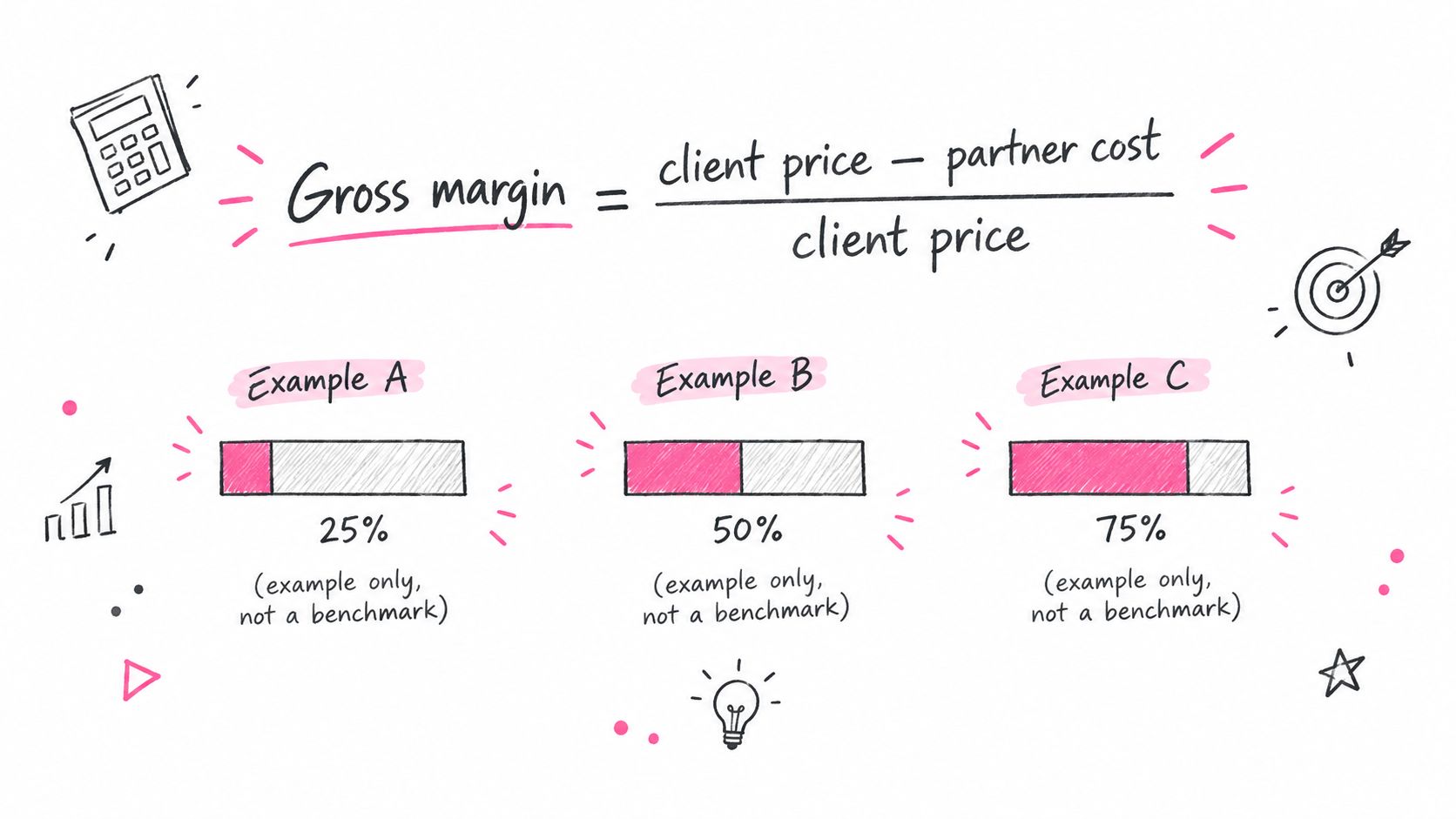
Start here and don't skip it. Gross margin equals client price minus partner cost, divided by client price.
This diagram shows the formula before we run the numbers.
Illustrative monthly margin scenarios
| Client monthly fee | Partner cost | Gross profit | Gross margin |
|---|---|---|---|
| $2,000 | $1,000 | $1,000 | 50% |
| $3,500 | $1,400 | $2,100 | 60% |
| $5,000 | $2,250 | $2,750 | 55% |
These are worked examples, not industry benchmarks. Row one is simple. $2,000 minus $1,000 leaves $1,000. Divide $1,000 by $2,000 and you get 50%.
Row two leaves $2,100. That's $3,500 minus $1,400, divided by $3,500, which gives 60%. Row three reverses the math. At a $5,000 fee and a target 55% margin, you keep $2,750, so partner cost can't exceed $2,250. Run your own prices through a tool like this cold email ROI calculator for outbound scenarios instead of doing optimistic napkin math.
This short walkthrough shows the same arithmetic in action.
Where the Spread Leaks
That spread is only layer one. Real margin gets chewed by quiet costs:
- Account management time: your team still runs calls, reviews work and calms nerves
- Revisions beyond scope: extra rounds nobody priced
- Reporting packs: turning partner data into client-ready stories takes hours
- Early churn: clients who leave in the first 90 days strand your setup effort
- Ad spend pass-throughs: clients expect you to float media before reimbursement
Before you model anything, confirm what any platform fee covers and what any commission applies to. A percentage on closed deals sits outside the monthly spread and changes the result completely. In our white-label setup, we're pay-per-close and resellers keep 100% of the margins while we handle fulfillment, so your resale price is yours to set.
Don't judge a channel on month one. Set an internal baseline across at least one full sales cycle. Compare outsourced and in-house delivery on contribution margin, capacity use, retention and client-facing quality. That's slower than a gut call. It's also how you avoid celebrating revenue that loses money without anyone noticing.
Who Owns the Client When the Work Goes Wrong
Hiding your fulfillment provider isn't the same as delivering a smooth experience. That's the uncomfortable bit nobody puts on a sales page.
The communication gap is already wide. 80% of marketing leaders reportedly consider clear communication critical, while only 55% are satisfied with it, a 25-point expectation gap on agency communication. Add an invisible third party and that gap can swallow your best client whole.
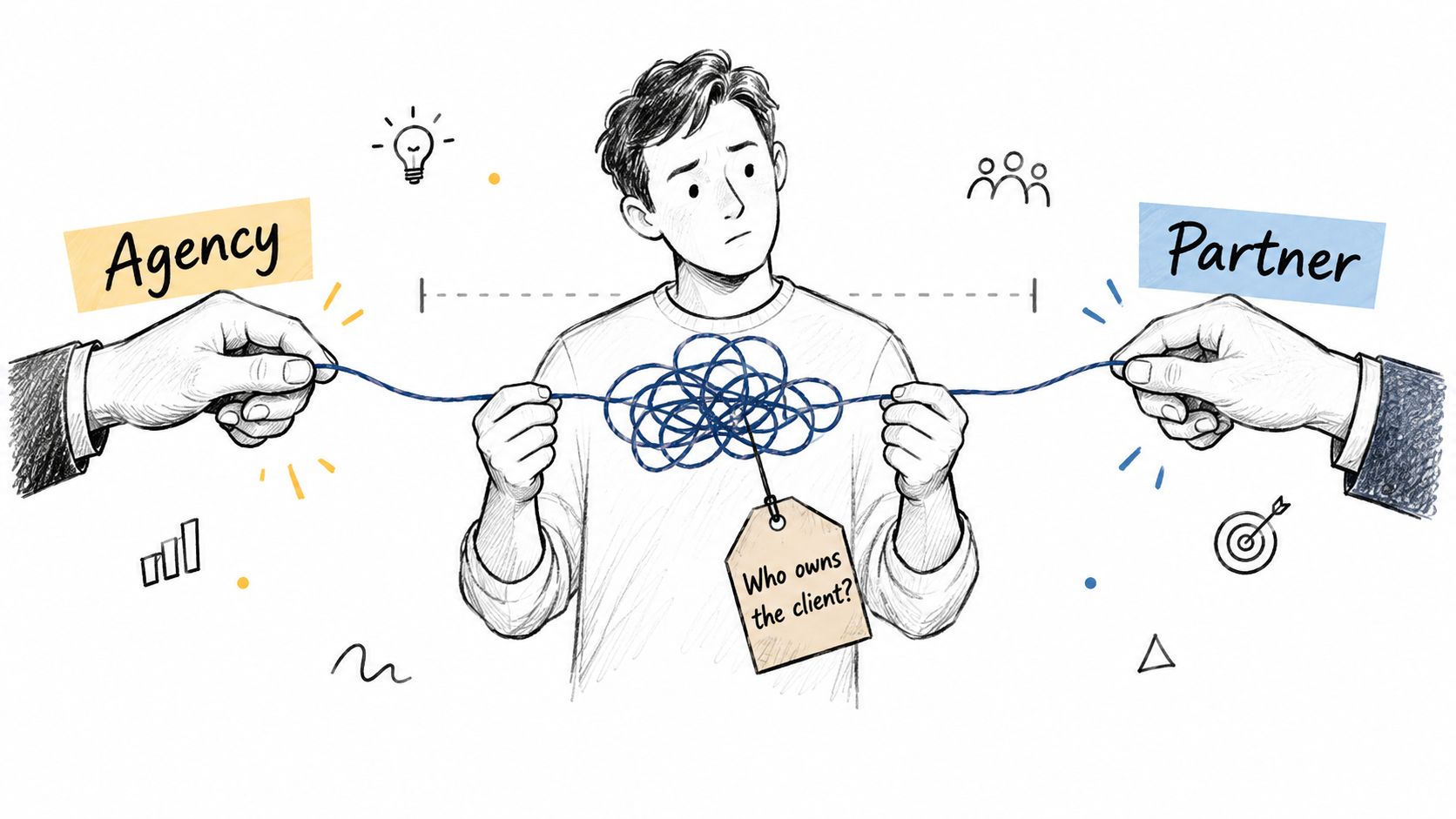
This picture captures the moment every reseller dreads.
The Week Three Test
Booked calls drop by half in week three. Now what? Who notices first, you or the partner? Who pauses sends, who tells the client, who approves a service credit, and who runs the root-cause review?
If your answer involves shrugging, you don't have a white-label system. You've got a subcontractor and hope. Hope isn't a retention strategy.
What to Name in Writing
- Escalation owner: one named person who owns problems, not a shared inbox
- Response times: how fast you'll both reply when something breaks
- Reporting rights: what data you can show clients, in your branding
- Approval workflows: who signs off copy and offers before launch
- Definitions: what counts as a qualified lead or meeting, exactly
- Remedies: refund or service-credit rules agreed in advance
- Audit rights: how you check the work without exposing the partner
Practical rule: if you can't explain last week's performance to the client in two minutes using data you can see, the arrangement is too opaque.
Transparency protects you, not just the client. An agency that can't explain its own numbers loses trust even when the underlying work is fine. The logo on the report is the least important part. Visibility is the product.
Deliverability and Compliance You Inherit
Deliverability isn't a copywriting problem with good subject lines. It's an authentication and reputation engineering problem, and you inherit the consequences even when someone else presses send.
The thresholds are concrete. Google defines a bulk sender as sending close to 5,000 or more messages to personal Gmail accounts within 24 hours, and since February 2024 those senders must authenticate mail, avoid unwanted messages and provide easy unsubscribe, per Google's bulk sender requirements for Gmail. Google recommends keeping the user-reported spam rate below 0.1% and preventing it reaching 0.3%.
Marketing messages also need one-click unsubscribe through List-Unsubscribe headers. That isn't decoration. It's the difference between a healthy program and a domain your client can't use anymore.
Ownership Questions for Your Contract
- Domains: who registers and controls sending domains?
- Suppression: who owns consent records and the master suppression list?
- Unsubscribes: who processes them and how fast?
- Complaints: who monitors rates and who can shut a campaign down?
- Incidents: who responds, and which privacy rules apply in each geography?
Authentication alone won't save you. Mailbox providers also weigh engagement and complaint behaviour, and authenticated mail can still land in spam. So track complaint rate and authentication pass rate alongside sends and booked calls, and sanity-check setup with an email deliverability checker before campaigns scale.
The Legal Layer
U.S. CAN-SPAM rules add teeth. The FTC says commercial email can't use false headers or deceptive subject lines, must offer a functioning opt-out that stays working for at least 30 days, and businesses must honor opt-outs within 10 business days, with each violating email carrying a penalty of up to $53,088, according to the FTC CAN-SPAM compliance guide for businesses.
That means you need accurate sender identity, truthful copy and centralized suppression. A prospect who opted out once must never resurface in another campaign. If your partner can't document that process, don't resell the service.
How to Choose a White Label Partner
Use this checklist as your starting point, then work through it step by step.
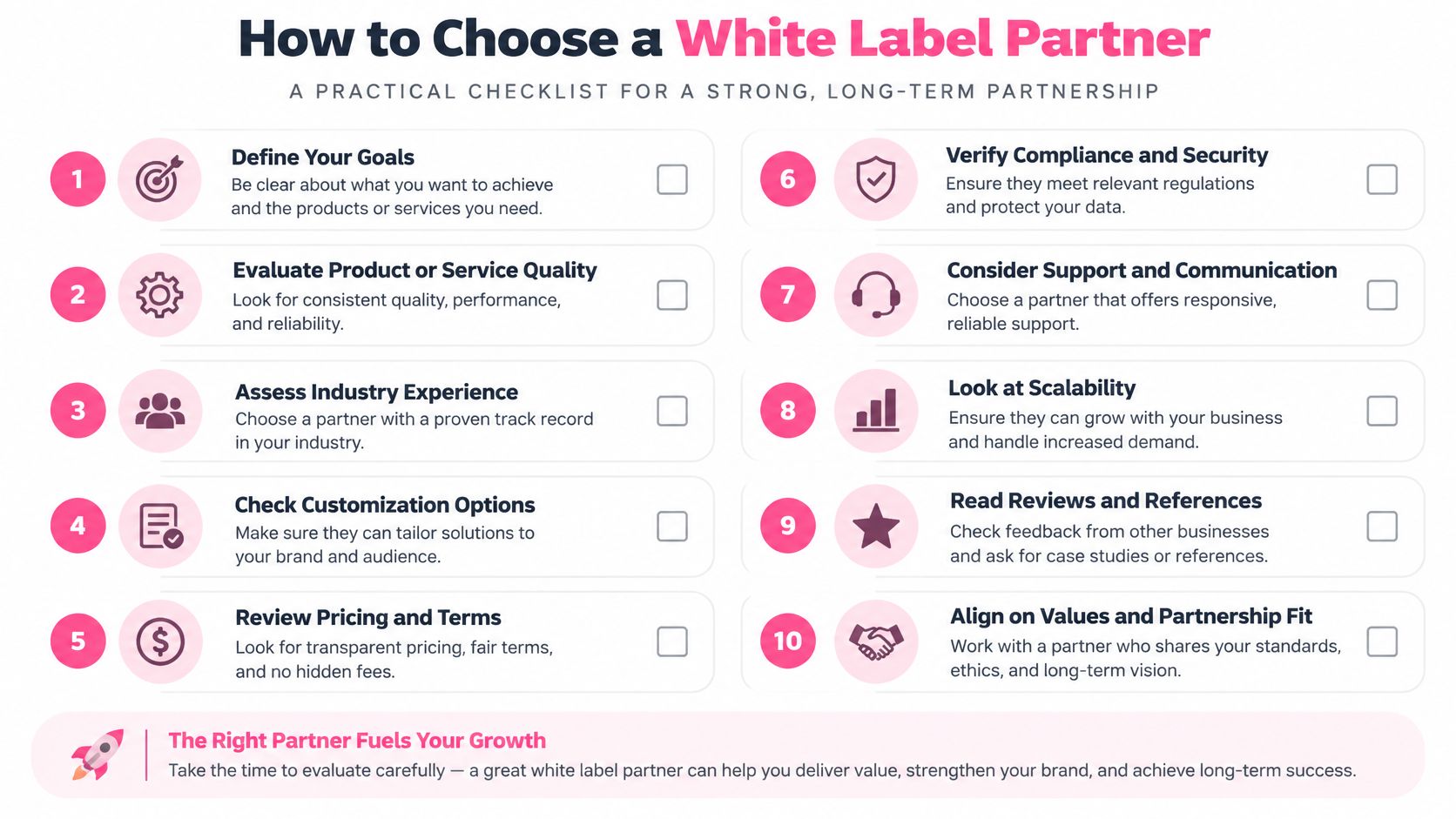
Map what you'll actually resell. List the services clients already ask for, whether that's SEO, paid, email or outbound. Vetting twelve capabilities you'll never sell wastes everyone's afternoons.
Demand written service levels. Cover targeting, list verification, copy approval, reply handling, booking, reporting and escalation. Undefined work can't be audited, and unaudited work can't be defended on a client call.
Ask for named results you can probe. We're pay-per-close, and our published examples include Locale Marketing Collective booking its first call within two weeks and BoostUrBusiness closing 6 deals in 4 weeks. Other results include The Tax Engineers with 2 closed deals in 2 weeks, highMpact with 5 Dream Clients in Month 1, and Left Mind Media with 34 Calls in the First Month. Ask every candidate for that level of specificity, then ask how the numbers were counted.
Pin down the commercial model. Confirm what fees and commissions apply to, the accepted-lead definition, attribution rules and the dispute window. Money arguments are cheapest before money moves.
Check compliance ownership directly. Who holds the domains? Who keeps the suppression list? How are opt-outs processed and evidenced? Use the ownership questions from the section above and don't accept vague nods.
Test reporting access before signing. Log in. Click around. If you can't find last week's activity yourself, your clients will be reading summaries you can't verify, and that's a bad place to stand.
A partner who won't show you their reporting before the contract won't show you better reporting after it.
Three Red Flags
- No written service levels: everything is verbal and everything is fine, allegedly
- No named escalation owner: problems go to a queue, not a person
- Guaranteed results with no attribution method: big promises, no way to prove or dispute them
Walk away from any two of those. Walk faster from all three.
Run a Pilot Before You Sign Anything
A good pilot is a small bet with sharp edges. Pick one service line, one client segment and one offer, then write a one-page scorecard before any partner gets to demo. If the offer is muddy, scale will only make the mud deeper. A narrow test can still carry real signal: T6 Marketing's reported 10-20x ROI within 4 weeks is the kind of result you want measured cleanly, not explained away later.
Track five numbers and nothing decorative:
- Valid-contact rate: are you reaching real people at real inboxes?
- Positive-reply rate: is the message earning a response?
- Qualified-meeting rate: are replies becoming conversations?
- Show rate: do booked calls happen?
- Opportunity-to-close rate: does pipeline turn into revenue?
Before launch, record baselines and set the exits in writing: failure threshold, pause trigger for bounces or complaints, review date, named owner on both sides, and the exact point where either party can walk without penalty. Run 90 days. Check reporting access in week one yourself. If deliverability slips, decide in advance who pays for new domains, warmup time and lost sends; pilots turn expensive when liability is “shared” but no one knows which wallet.
Give two candidate partners the same brief and judge them on the same five metrics. Our own fit is narrow and easy to test: done-for-you client acquisition from $97/mo, first 2 closes free, then 5% per close. Keep the model in the scorecard too, because pay-per-close moves risk toward the partner only when attribution, refund rules and exit rights are written down.
Choose the scorecard that survives contact with reality. A smooth pitch is cheap. Month-four delivery is the invoice.
Ready to resell outbound acquisition under your own brand without hiring the fulfillment team? Ever Outbound Inc. handles list building, copy, infrastructure, appointment setting and reporting while you keep 100% of the margins and the client relationship. Bring one offer, one segment and your exit criteria; judge us on the same scorecard.