November 13, 2026
White Label Lead Generation Agency: Models and Red Flags
You've won the client. They want pipeline, you've promised a launch, and your team is already juggling strategy, creative revisions, and an inbox that qualifies as a public emergency. Outsourcing the prospecting looks sensible. Then a provider sends a beautiful branded dashboard and a contract that says almost nothing about who owns the conversations.
That's where a good white-label deal turns bad. The battleground isn't the logo, it's the exit. Before comparing margins, establish who keeps the data, who gets credit for a sale, and what happens when either party walks away.
Table of Contents
- What a White Label Lead Generation Agency Actually Does
- Pricing Models Compared, From Retainers to Pay-Per-Close
- Benefits and Drawbacks for Resellers and Their Clients
- Evaluation Checklist Before You Shortlist a Provider
- Contract and SLA Terms That Protect Your Pipeline
- How to Onboard and Connect Your Lead Pipeline
- Red Flags That Should End the Conversation
- Choose Your Partner and Book a Pilot This Quarter
What a White Label Lead Generation Agency Actually Does
Say your boutique marketing agency signs a cybersecurity consultancy. You can position its offer and manage the relationship, but nobody has time to research security leaders, write outreach sequences, or prepare sending mailboxes.
A white label lead generation agency runs that specialist work behind the scenes under your brand. Think of a ghost kitchen cooking dishes that another restaurant serves under its own name. Your customer buys your service; another team handles the production.
Who Does What
- The reseller owns the commercial relationship. You handle positioning, pricing, proposals, invoicing, and client expectations.
- The provider handles fulfillment. Its team researches prospects, verifies lists, writes outreach, sets up and warms mailboxes, sends campaigns, manages replies, and books appointments.
- Both parties approve the boundaries. Targeting, messaging claims, qualification criteria, and handoff responsibilities need agreement before launch.
Typical resellers include marketing and creative agencies, consultancies, managed service providers, recruiters, coaches, and B2B SaaS teams. The model is especially useful when you understand a client's market but don't want to build an outbound department.
This isn't an unusual workaround. In 2024, 46.2% of marketers reported outsourcing at least one marketing function during the previous year, according to Marketing Week's Career & Salary Survey.
Specialist market knowledge still matters. An agency serving franchise brands, for example, can use Franchise Foundry's guide to ways to generate more franchise leads to sharpen the acquisition brief before delegating execution.
A lead-list vendor delivers records. A managed white-label provider runs the campaign that turns suitable records into sales conversations.
You can sell a pipeline service without building its fulfillment machinery. You can't outsource responsibility for what you promised the client.
Pricing Models Compared, From Retainers to Pay-Per-Close
| Model | How the Provider Is Paid | Who Carries the Risk | Best Fit |
|---|---|---|---|
| Monthly retainer | Fixed fee every month | Client pays whether or not meetings book | Agencies with steady budget and proven demand |
| Per lead | Fee per delivered contact | Client pays for list volume, not quality | Teams that qualify leads in-house |
| Per booked meeting | Fee per qualified meeting | Shared, with some risk on meeting quality | Resellers who need a predictable calendar |
| Pay-per-close | Commission on closed deals | Provider carries most of the acquisition-performance risk | Clients who want outcome alignment |
| Revenue share | Percentage of deal value | Allocated through written attribution and payment rules | Resellers with clear attribution terms |
Pricing models for white label lead generation look similar in proposals. They behave very differently when a campaign struggles.
A retainer buys ongoing work and capacity. If the provider researches accounts and runs campaigns but nobody books, the invoice still arrives. That can be sensible for an established offer, provided you're buying defined execution rather than optimism with a direct debit. Use this retainer-based lead generation comparison to examine that trade-off.
Per-lead pricing rewards delivery volume unless qualification is contractual. In a hypothetical campaign, a batch of 500 unsuitable contacts could generate the same invoice as 500 suitable buyers if the agreement defines a lead as merely a valid contact.
Per-booked-meeting pricing moves the purchase closer to a useful outcome. But a meeting with someone who can't influence a purchase still costs money unless the qualification and replacement rules exclude it.
Pay for the Outcome You Can Verify
With pay-per-close, commission becomes payable when an attributable deal closes. The provider accepts more performance risk, although the client still contributes sales time and may pay infrastructure costs.
At Ever Outbound, we're pay-per-close. Fully done-for-you client acquisition starts at $97/month, with the first 2 closes commission-free, then 5% per close. The monthly fee covers infrastructure and tools, so no commission doesn't mean no cost.
Revenue share can extend beyond an initial sale into an agreed revenue stream. Say an agency client signs a recurring contract: the agreement must specify whether the provider participates in the first payment, renewals, or some defined period. Otherwise, you're negotiating a subscription to future arguments.
Lead price alone is a poor buying criterion. Industry benchmark summaries compiled by Statistics Fundamentals report that approximately 79% to 80% of marketing leads never convert into sales, with average B2B cost per lead across channels at about $198.
For a hypothetical calculation, a $2,000 monthly fee plus 10% commission on $50,000 of attributable closed revenue totals $7,000. Divide total fees by realistic closes, then add tools and your team's delivery time. That's a more useful comparison than the headline price.
Benefits and Drawbacks for Resellers and Their Clients
White-label fulfillment isn't passive income. You're exchanging internal production work for supplier management, quality control, and contractual risk. Done properly, that's an excellent trade. Done casually, you become the apologetic person between two annoyed companies.
In 2024, 53% of B2B marketers said they'd outsourced an element of their business, compared with 40.6% of B2C marketers, according to Marketing Week's Career & Salary Survey. B2B teams already rely on outside execution, but familiarity doesn't remove the need for oversight.
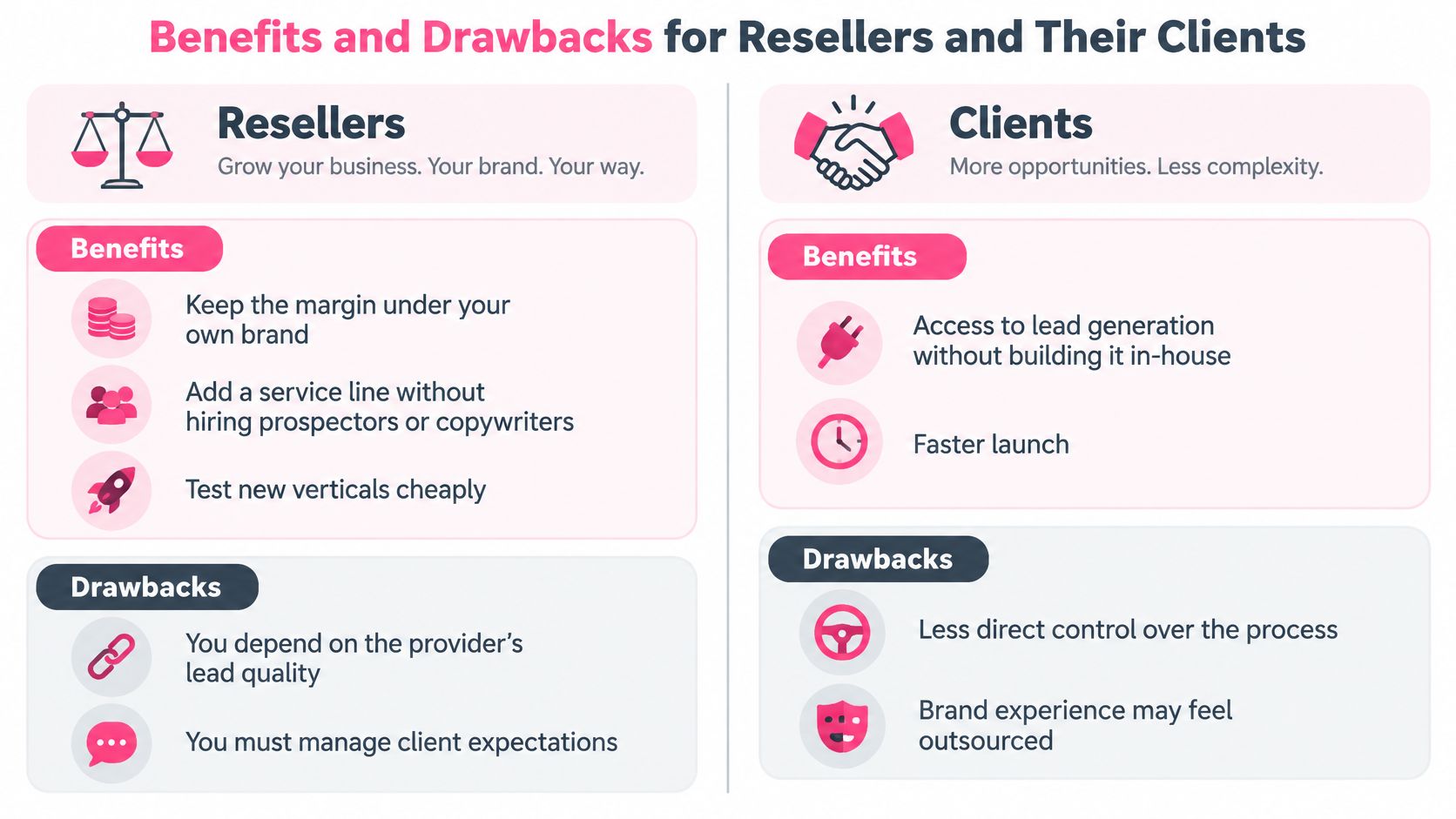
The ledger has benefits and liabilities on both sides.
The Reseller's Ledger
You can retain your brand and markup, introduce a service without hiring prospectors or copywriters, and test a vertical without committing to permanent payroll. Our agency partnership follows that fulfillment split: you retain the client relationship while we handle delivery, and we're pay-per-close.
But the supplier controls its capacity and commercial terms. If it slows production or changes pricing, you still have a client expecting delivery.
Accountability also gets slippery. A poor meeting can trigger a familiar exchange: your account manager blames targeting, the supplier blames the offer, and nobody fixes the handoff. Assign an owner to investigate rejected meetings, not merely forward complaints.
The Client's Ledger
Clients gain access to specialist research, organized follow-up, and a faster route to launch. For a ready offer, booking conversations in weeks rather than waiting through a lengthy hiring process is the attraction, not a guaranteed timetable.
The drawbacks have specific mechanisms:
- Shared reputation exposure. One client's complaints can threaten other campaigns using shared infrastructure. Google's Gmail sender guidelines require user-reported spam rates below 0.3%, making campaign isolation commercially important.
- Reduced operational visibility. Reports can conceal daily activity if the client can't inspect underlying records.
- Slower answers. Every technical question takes longer when it travels through a reseller who lacks direct access.
The model suits resellers who actively own the relationship and negotiate data rights before launch. It doesn't suit anyone hoping fulfillment will manage itself.
Evaluation Checklist Before You Shortlist a Provider
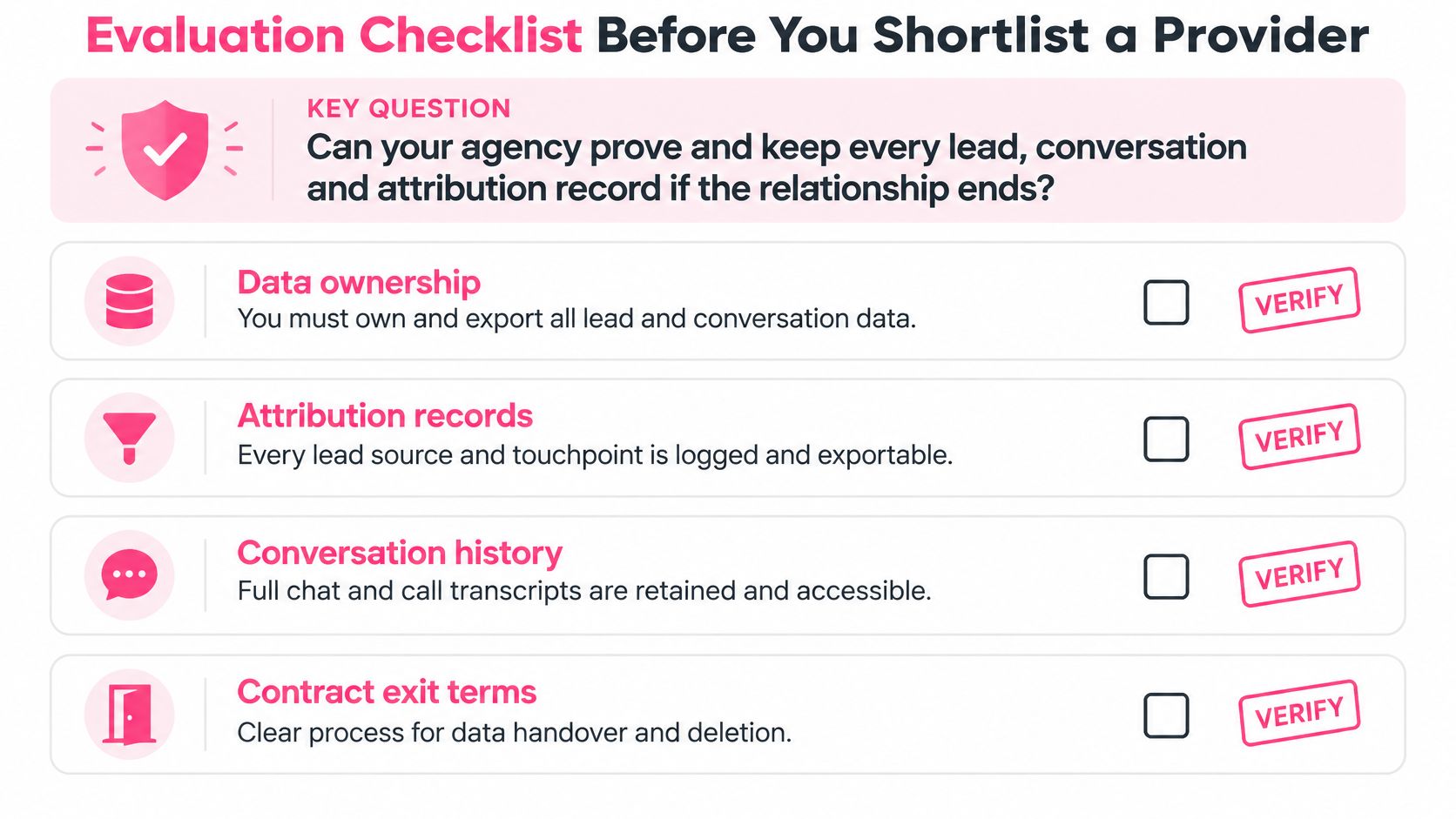
Can your agency prove and keep every lead, conversation, and attribution record if the relationship ends?
That question matters more than whether the dashboard matches your brand palette. White-label arrangements can leave contacts, workflows, and communication histories inside supplier-controlled accounts, an ownership concern discussed in Hustle Marketers' white-label lead generation guide.
Separate prospect data, sending domains and mailboxes, CRM records, and performance evidence. Give each asset a named owner, access permissions, and a transfer rule. Access isn't ownership, and a screenshot isn't an export.
Use the checklist to test what you can retain.
Require Demonstrations, Not Assurances
Client-owned CRM access. Keep the operating history somewhere the client controls, with an agency-managed login. Test whether your administrator can retrieve records without supplier assistance.
Exportable activity logs. You need evidence of who contacted whom and when. Request a sample export containing contacts, timestamps, source fields, and conversation activity before signing.
Campaign assets in your workspace. Store approved copy, targeting definitions, and workflow documentation outside the supplier's master account. Open the files during the demonstration and confirm your team can edit them.
A dated offboarding procedure. The handover needs an owner and a deadline. Request a sample exit pack and identify which assets require migration rather than a simple download.
Auditable attribution rules. Require written windows, source IDs, exclusion lists, and treatment of duplicate leads or pre-existing opportunities. Test a scenario where an old opportunity reappears through outbound.
Named human oversight. Someone must review prospect fit and interpret replies. We use human research, copywriting, and appointment-setting teams with AI assistance; review the actual approval and escalation workflow.
A usable deliverability view. Authentication status, complaint information, and sending caps should be visible. Our platform shows infrastructure health and live activity; require the demonstration to show how an operator investigates a problem.
An itemized commercial schedule. Separate platform costs, infrastructure, fulfillment, commission, and optional work. Compare the proposal against the order form rather than trusting a starting-price headline.
Apply that standard to every shortlist candidate, including Ever Outbound, we're pay-per-close. Review our client results, then request a live demonstration of the operating outputs rather than a presentation about them.
Ownership test: If the provider can't show you how to retrieve the data, don't assume it's yours.
Contract and SLA Terms That Protect Your Pipeline
| Clause | What to Specify | Red Flag |
|---|---|---|
| Opt-out handling | Honor requests within 10 business days; mechanism works for at least 30 days, as required by the FTC's CAN-SPAM guide | Opt-out requires a phone call or a multi-page form |
| Spam complaint ceiling | Target below 0.1%; pause at 0.3%; mitigation recovery requires 7 consecutive days below 0.3%, following Google's sender FAQ | No complaint threshold in the contract |
| Sender of record | Named responsible party for each sending domain | Provider responsibility is unnamed or ambiguous |
| Compliance records | Client-owned copy of suppression lists, contact sources, collection dates, and consent evidence where applicable | Records held only in the provider's account |
| Market compliance | Applicable legal basis and source recorded per contact; privacy information for EU and UK recipients | No documented assessment of applicable rules |
| Bulk sending controls | One-click unsubscribe for applicable promotional Gmail sends at 5,000+ messages daily, under Google's sender FAQ linked above | No pause or recovery procedure |
| Attribution window | Written number of days and a deal-matching rule | Credit for any deal the provider touched |
| Offboarding | Full export of contacts, logs, and assets within an agreed deadline | No exit process described |
These contract and SLA clauses convert reassuring sales language into responsibilities someone can enforce. Have counsel review the agreement, particularly when your client contracts promise more than your supplier contract delivers.
Make Suppression an Operating Responsibility
CAN-SPAM doesn't permit an opt-out fee or a cumbersome process demanding unnecessary information. Name who processes requests, maintains suppression records, handles complaints, and ensures excluded contacts don't re-enter another sequence.
The advertised business doesn't shed its obligations by hiring someone else to press send. Identify the responsible sender and require accurate headers and subject lines, not just an unsubscribe footer.
Separate Recovery Eligibility From Permission to Restart
Google's mitigation-recovery condition isn't a promise that restarting a campaign is safe. Your operator should investigate the complaint source, correct targeting or messaging, and obtain approval before resuming. A quiet dashboard after sending stops isn't proof that the original problem disappeared.
For international outreach, SyncGTM's cold-email law guidance supports recording source provenance, collection dates, applicable legal basis, and privacy information. Require a market-specific assessment for EU and UK recipients; a documented lawful basis isn't blanket permission to send.
The SLA should also require:
- Weekly operational reporting. Include complaints, delivery problems, suppression processing, and remediation decisions.
- Campaign-level isolation. Document how an operator pauses one client without disrupting unrelated campaigns.
- Evidence retention. Set access roles, retention limits, and procedures for deletion requests or legitimacy challenges.
Use our published terms as part of your review, not as a substitute for confirming the requirements of your particular engagement. We're pay-per-close, but outcome-based pricing doesn't replace operational safeguards.
Put negotiated protections in the master agreement or incorporated SLA. A sales slide is a poor place to store your legal rights.
How to Onboard and Connect Your Lead Pipeline
Onboarding is where commercial promises become working systems. Fixing an ownership gap before launch is cheaper than discovering it while a client demands its records.
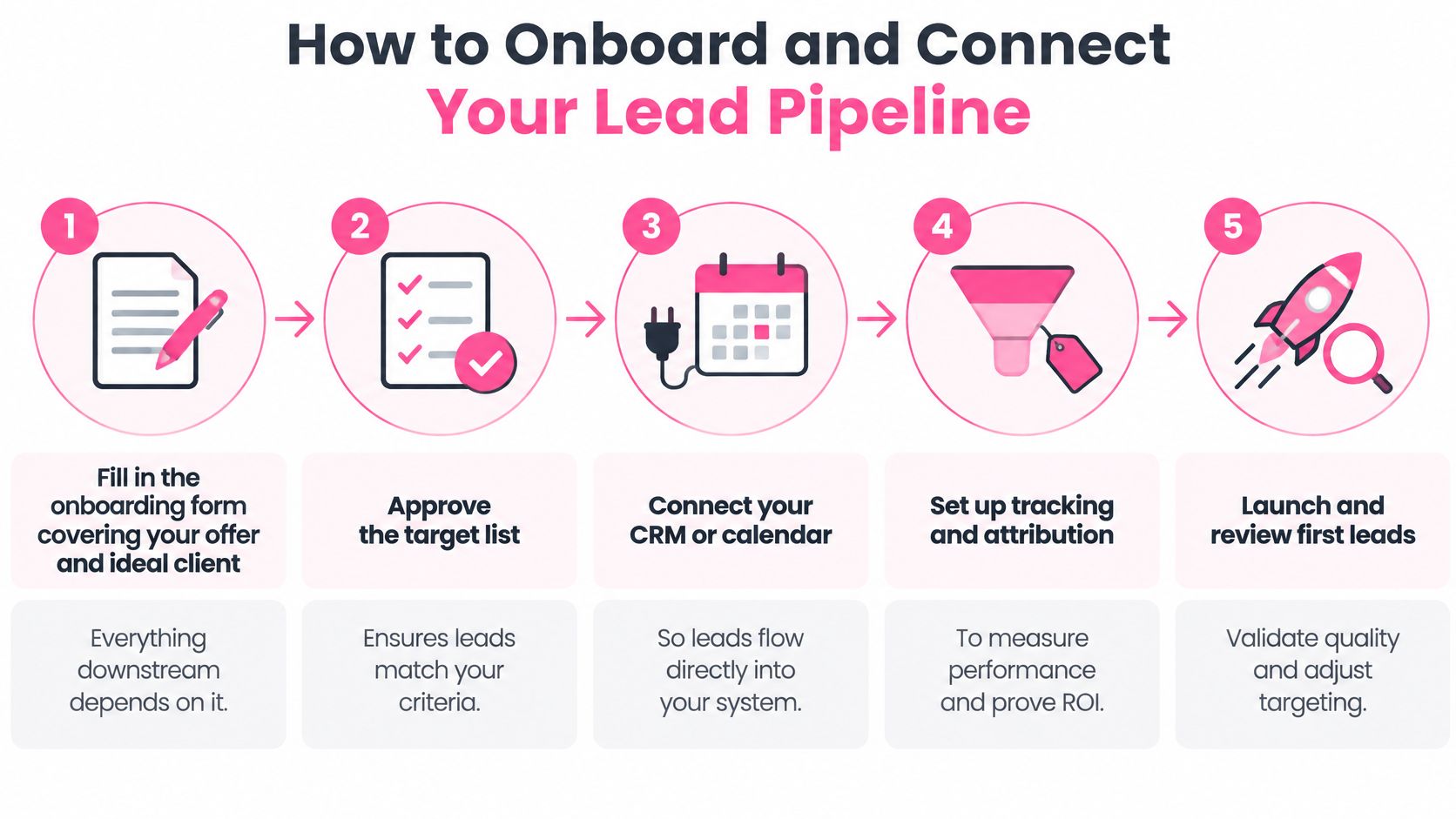
Our managed onboarding process starts with a short form about your offer and ideal client. We handle list building, copywriting, sending, and booking calls, and we're pay-per-close.
Use this flow to organize the handoff.
Launch in a Controlled Sequence
Complete the offer brief. Describe the customer problem, buying trigger, service boundaries, and evidence you can substantiate. Weak inputs produce polished messages to the wrong people.
Approve the targeting definition. Specify job titles, company sizes, industries, locations, and exclusions. Record whether existing clients, open opportunities, and competitors must be removed before research begins.
Prepare sending infrastructure. Establish domain and mailbox ownership, enable authentication, and verify configuration before warming and ramping. Warmup isn't a substitute for relevant messages or clean targeting.
Inspect verified prospect samples. Review actual companies and contacts rather than accepting a category label. Catching stale roles or unsuitable industries now prevents an entire campaign from following the wrong brief.
Approve outreach sequences. Check every promise against what the client can deliver, including claims embedded in follow-ups. Give one named person final approval so revisions don't become a committee sport.
Connect the CRM and calendar. Agree source fields, campaign identifiers, opportunity matching, and booking ownership. Test the full journey with a sample record before relying on it for commission reconciliation.
Ramp cautiously and inspect complaints daily. During the first week, review replies and infrastructure signals alongside booked calls. An operator should be able to reduce volume or pause a segment without waiting for the next account meeting.
Reconcile bookings across systems. Sync calls into your own records regularly and investigate mismatches. Our meetings API returns calls shown in the dashboard and supports date filtering based on when the call was booked, with pagination for retrieving the records.
The first successful integration isn't a calendar notification. It's a booking you can trace from campaign activity to your own CRM record.
Treat the first two weeks as an acceptance window, not a guaranteed meeting deadline. Healthy signs include authenticated domains, complaints staying beneath your agreed target, complete activity records, and any booked meetings appearing in both systems.
Red Flags That Should End the Conversation
A discovery call should reveal how a provider works. If every operational question produces another testimonial, you're attending a magic show.
Keep the conversation focused on the people and processes behind the pitch.

Listen for These Sales-Call Moments
The calendar guarantee arrives before the targeting questions. Ask: Who qualifies for those meetings? A credible answer defines account fit, relevant roles, and disqualifiers before promising volume.
The headline price survives until the order form opens. Ask: What must I buy beyond this price to launch and operate? A good answer itemizes required charges and distinguishes optional services.
Everything runs automatically, apparently including judgment. Ask: Who reviews ambiguous replies and unsuitable prospects? Expect named responsibilities and an escalation path, not another description of the AI.
Lead quality requires more than form submissions or positive replies. For agencies combining outbound with paid acquisition, Rapid Ads' guide to improving lead quality on Meta is a useful companion when defining what actually qualifies.
Use the same skeptical lens while reviewing the provider's explanations.
The case study features an anonymous company and excellent vibes. Ask: What measurable outcome can I verify? A sound answer supplies named evidence where permitted, or a credible reference process when confidentiality applies.
Pay-per-close has no definition of closed. Ask: What event triggers commission, and which existing opportunities are excluded? Expect an explicit deal event and a reproducible matching rule.
The sending domains are somehow confidential. Ask: Which domains represent my client? A good answer identifies the assets and permits authentication checks.
A provider unable to discuss complaint handling or offboarding is avoiding the parts that matter most. Don't reward that performance with a signature.
Choose Your Partner and Book a Pilot This Quarter
Buyers aren't universally hostile to vendor contact. In 2025, 88% of B2B buyers said they wanted to hear from vendors while researching and evaluating options, according to Sopro's State of Prospecting report. That supports relevant outreach, not indiscriminate sending.
Choose the provider that can demonstrate useful execution and survive a controlled exit test. The cheapest proposal deserves no special exemption.
Make the Pilot Earn Its Expansion
- Score the shortlist. Compare providers against the ownership checklist and contract clauses. Reject failures on data control or complaint handling before debating presentation quality.
- Cap the pilot. Set a budget, scope, review point, and qualification standard. Don't let a trial become an open-ended commitment.
- Measure commercial progress. Track qualified booked calls, attended conversations, and attributable closed deals. Raw contact volume belongs in an activity report, not the success headline.
- Test the unglamorous work. Review complaint handling and execute a sample offboarding export before expanding.
Define a qualified meeting around a relevant buying role, such as the economic buyer or technical evaluator. Gartner's buyer-enablement guidance describes typical B2B buying groups containing six to 10 decision makers, so one friendly contact shouldn't be mistaken for an entire opportunity.
Illustrative pilot, not a client case: A consultancy targets operations leaders at a narrowly defined set of firms. It accepts meetings only when the company fits, the contact influences the relevant purchase, and the problem matches the offer. Expansion requires usable sales conversations, clean records, and a successful handover test, not merely a busy calendar.
Treat Proof as Evidence, Not a Forecast
Job Calls, a marketing agency for home service contractors, got strong lead flow in 2 weeks. Rob Herget described his result this way:
“I've had six meetings so far and closed every single one. They became a client. It's been incredibly lucrative.”
Rob Herget
Those are specific outcomes, not promises for your campaign. Evaluate Ever Outbound using the same checklist, we're pay-per-close, so without attributable closes there's no commission, while the infrastructure fee remains separate.
Book two or three discovery calls this month. Bring the checklist and clause table to each, and make the providers demonstrate the work behind their promises.
At Ever Outbound Inc., we're pay-per-close and offer fully managed B2B client acquisition, including white-label fulfillment for agencies. Visit us to discuss your offer and a scoped pilot, and bring your questions about attribution, data access, and exit terms before you commit.