November 14, 2026
Outbound Lead Generation Service for B2B SaaS Buyers
The most popular advice in this corner of B2B is to book more meetings. Fill the calendar, lift the reply rate, add mailboxes until the pipeline chart points up and to the right. It's tidy, it's measurable, and it wrecks SaaS teams, because a calendar full of calls with people who never had budget is the most expensive activity report ever invented.
The market is large enough to support a better test. Grand View Research estimated the worldwide SaaS market at $464.7 billion in 2025, with projections of $530.0 billion in 2026 and $1.1092 trillion by 2033. Buyers exist in numbers. That doesn't mean they'll answer your email, and it certainly doesn't mean the person selling you a 10,000-contact list knows where any of them sit.
Judge an outbound lead generation service for B2B SaaS on two things instead: the closed revenue it produces, and who carries the financial risk while it tries. We're pay-per-close, so that's our answer to the second question. The rest of this is how to apply the test to us and to every other provider who sends you a deck.
Table of Contents
- What an Outbound Service Actually Hands You, Step by Step
- Pricing Models Compared, Including Pay-Per-Close
- Targeting and Copy That Earn Qualified Replies
- Deliverability Setup Your Provider Must Prove
- Questions to Ask Before You Sign
- How to Judge Results Beyond Opens and Lead Counts
- Outbound Versus Other Channels and In-House SDRs
- Run a 30-Day Pilot Before You Commit
What an Outbound Service Actually Hands You, Step by Step
A managed outbound lead generation service for B2B SaaS runs the same four-step chain whether the invoice says $97 or $12,000. What differs is how carefully each step is executed, and what the provider does when one of them breaks.
- Build a verified list of decision-makers. Companies filtered by size band, industry, technology stack and buying role. The filter that matters most is the buying role, because a perfect company with the wrong contact produces a polite no.
- Write and send short sequences from warmed domains. Copy built for that segment, not recycled from a different vertical. Three or four sentences, one idea, one ask.
- Route positive replies to a human or AI-assisted setter immediately. Classify the intent, answer the actual question, offer times.
- Hand the booked call to a founder or sales lead who closes it. No provider can do that part for you, and one who claims otherwise is selling you something else.
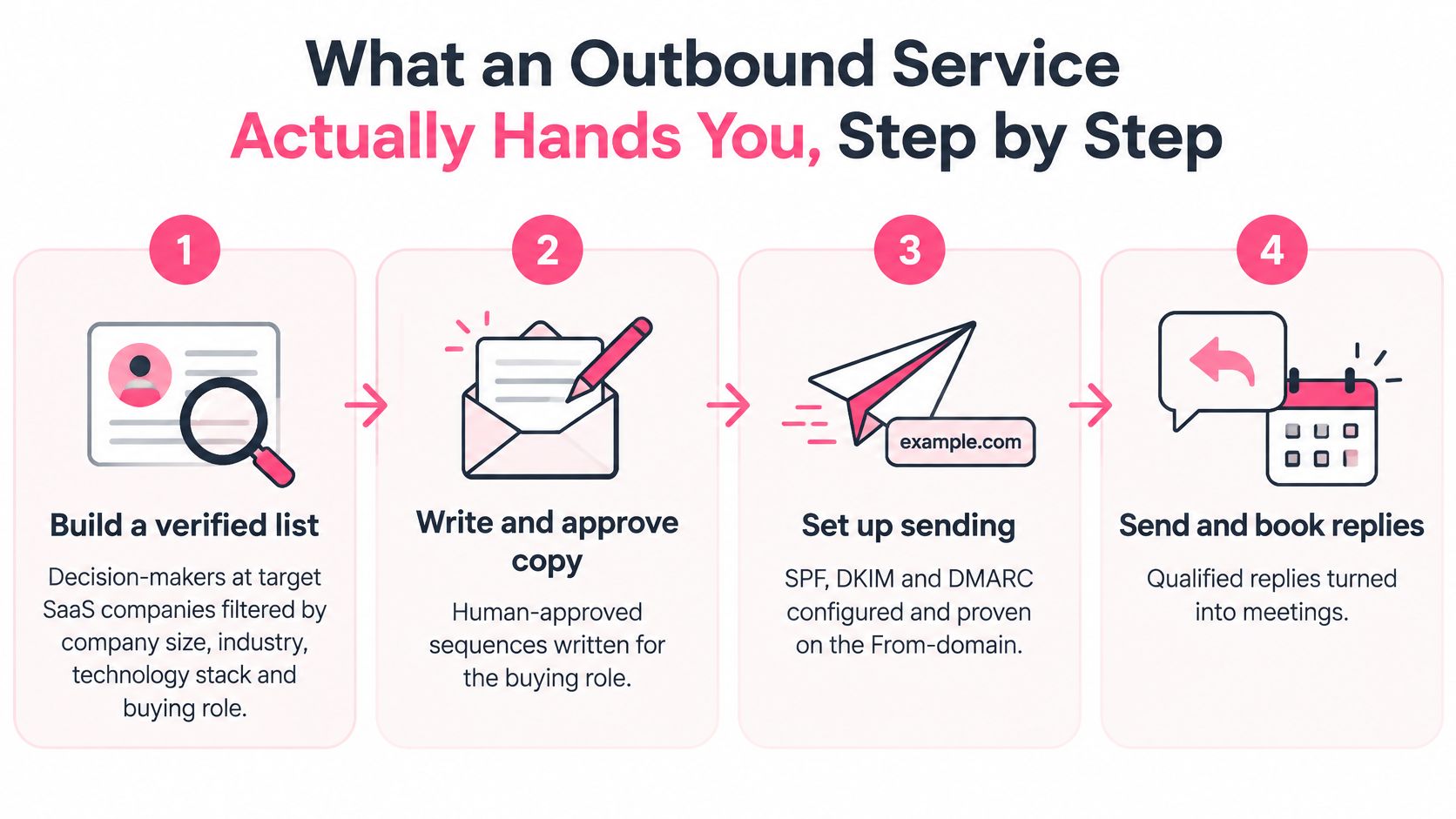
Each step starves the next. A weak list wastes good copy, because the reader was never going to buy. Good copy sent from a domain with no sending history never reaches an inbox, so nobody reads it. Fast reply handling on a vague offer books calls that don't qualify. A booked call your team can't close has burned everyone's calendar for nothing.
Where the chain breaks fastest
Reply handling is usually the cheapest step to fix and the one most providers treat as an afterthought. Research summarized by Wisestamp from Harvard Business Review found that companies contacting a lead within one hour were nearly seven times more likely to qualify that lead than companies waiting an additional hour. The mechanism is boring and reliable: a prospect who has just expressed interest still remembers why they replied.
Treat that hour as a ceiling, not a target. During staffed hours, five minutes is achievable and worth staffing for. Automated follow-up keeps things consistent, but technical objections, buying-committee hints and disqualification need a person.
Practical rule: If a provider can't tell you their median time from positive reply to first human response, they don't measure it. Unmeasured reply handling is measured in days.
Two limits worth stating plainly. No outbound service fixes product-market fit; if the demo doesn't land, better lists just make the failure arrive sooner. And no service closes for you, which is exactly why pay-per-close pricing puts a useful slice of the risk back where it belongs.
Ask for four artefacts before you sign: a sample list with the filters visible, the domain and mailbox setup, reply logs with timestamps, and meeting records showing who attended.
Pricing Models Compared, Including Pay-Per-Close
| Model | What You Pay | Who Carries the Risk | Best Fit |
|---|---|---|---|
| Monthly retainer | Fixed monthly fee, often plus setup | You, every month | Teams with a proven offer and budget to spare |
| Pay-per-lead | Fee for each lead delivered | Mostly you, since list volume is rewarded | Teams that already convert leads well in-house |
| Pay-per-meeting | Fee for each booked meeting | Shared, but unqualified calls still get paid | Teams that want calendar fills and can filter calls |
| Pay-per-close (Ever Outbound) | Plans from $97 per month plus 5% on closed deals; first 2 closes commission-free | Shared, since the provider earns only when you close | Teams that want incentives aligned with revenue |
| In-house SDR | Salary, tools and management time | You, including ramp time | Teams with steady volume and time to train |
Read the third column first. It decides what happens in month three, when the campaign has produced a handful of replies and none of them closed.
Monthly retainer. A fixed fee, usually with a setup charge on top. The agency is paid whether or not your pipeline moves, so the only thing at risk is your budget. It can be the cheapest option on paper for a team with a proven offer and a high close rate, because you're buying capacity rather than outcomes.
Pay-per-lead. You're invoiced per contact delivered. Volume becomes the supplier's friend, which makes list quality the first casualty. If your in-house team already converts raw leads well, this can work. For most SaaS teams it just moves the filtering cost onto the sales team.
Pay-per-meeting. A fee per booked call. Better than leads, with one flaw: the provider is paid for the booking, not for whether the prospect had budget, authority or a real problem. Expect a full calendar and a discovery-call graveyard unless someone on your side filters hard.
Pay-per-close. The provider gets paid when you win. We're pay-per-close: plans from $97 per month plus 5% commission on closed deals, with your first 2 closes commission-free. On a hypothetical $10,000 deal, the commission comes to $500 once the free closes are used. It's worth reading how the pay-per-close model works next to any retainer quote, because the comparison only holds when you plug in your own close rate.
Where each model actually costs you
Pay-per-close is more expensive on large deals. A 5% commission on a $100,000 contract is $5,000, and a retainer might have produced the same meeting for less. That assumes your close rate is healthy and those meetings were going to happen anyway, which is a generous assumption for a team still sharpening its offer.
The reverse case is just as real. At a 10% close rate, a retainer bills you every month for a small number of deals, and nobody renegotiates because the contract renews itself.
The test that matters: Which model keeps the provider paid only when the work is working, and can you verify that in your own CRM rather than in their dashboard?
Targeting and Copy That Earn Qualified Replies
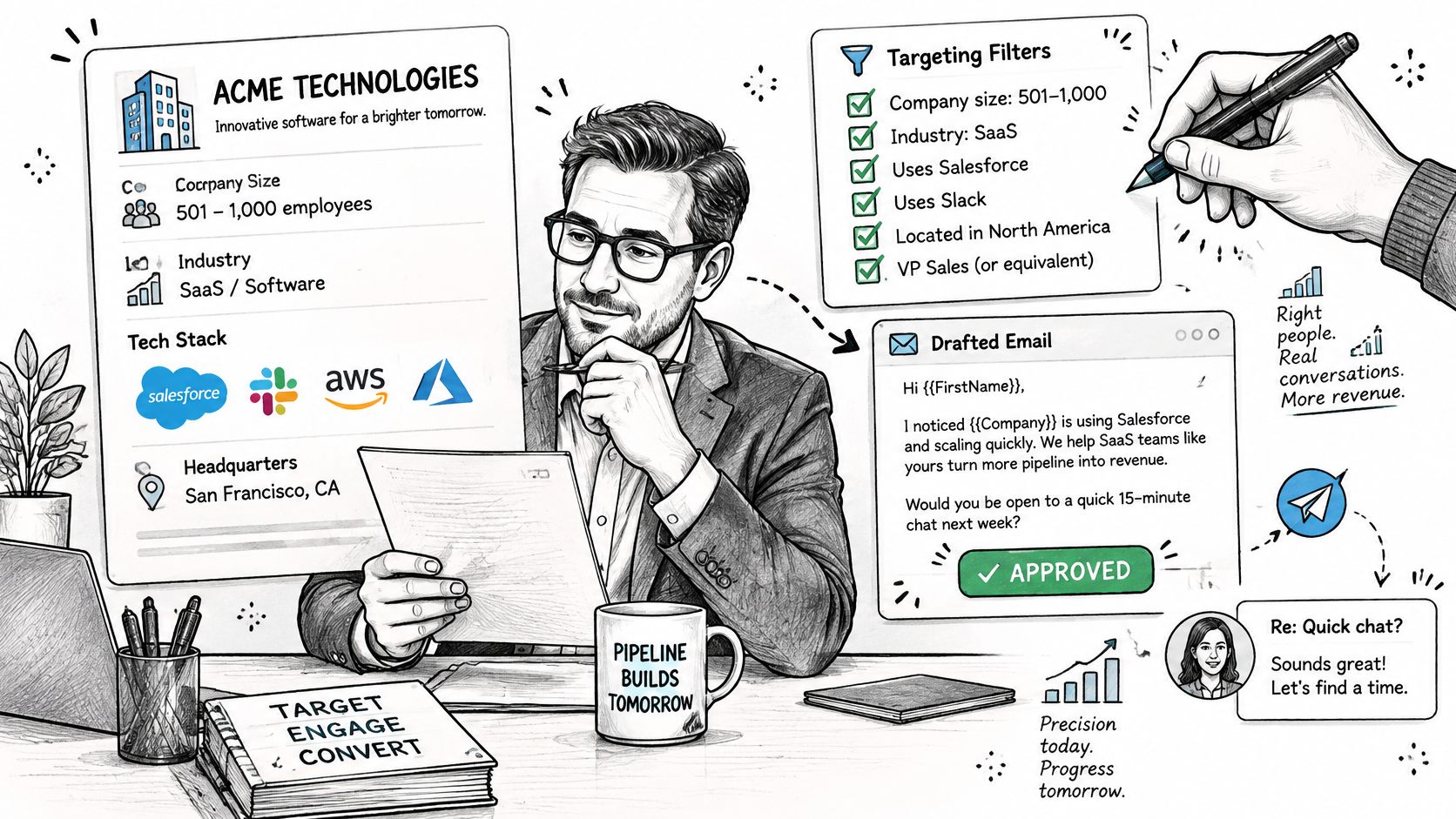
An outbound lead generation service for B2B SaaS is only as good as the list underneath it, and most lists are bad for one specific reason: they were assembled for volume, not fit. Hand-picked beats bought. Our team hand-picks and verifies ideal prospects using AI-enhanced targeting to build laser-focused lists of decision-makers, and the verification step matters as much as the picking, because dead addresses drag sender reputation down at exactly the moment you're trying to build it.
What an ideal client profile looks like for SaaS
Five fields, all required. Company size band, with a real floor and ceiling, since a 20-person startup and a 4,000-person enterprise don't share a buying process. Product category narrow enough that the offer can name a workflow. Technology signals, meaning the tools already in the stack, which reveal whether integration is a question or a deal-breaker. Growth stage, because hiring patterns and funding events create timing. The signing role, whether that's head of revenue, VP sales or a RevOps lead.
Take a workflow tool aimed at RevOps leads. The opening line isn't a compliment about their latest webinar. It's a question about hours lost to manual CRM syncs each month, with the consequence attached. From there, outbound programs built for SaaS companies run per segment rather than per industry label, and the offer is written from scratch for that segment because a conversion-tested offer for one vertical tends to die in the next.
The call to action that earns a reply
Here's where most sequences lose the plot. Gartner's 2025 sales survey found that 61% of B2B buyers prefer a rep-free buying experience, and 73% actively avoid suppliers that send irrelevant outreach. Asking a researcher who is three weeks from forming a shortlist to "grab 15 minutes" is the fastest route to becoming the irrelevant supplier.
The split that works: send a useful, self-contained resource to early-stage researchers, and reserve human outreach for the contextual questions self-service can't answer, like fit, implementation, security and integration. Gartner also found buyers prefer digital self-service for general information but seller input when determining whether a solution fits their company, which supports the same sequencing.
Skip the personalization built from a prospect's podcast appearance, hiring page and dog's name crammed into one paragraph. Prospects read it as surveillance, and they're right.
Split test worth running: Two versions of one sequence, one asking for a call and one offering a diagnostic. Compare qualified progression, not replies.
Once a sequence produces a resource worth sharing, that asset earns a second life on social. A LinkedIn post scheduler lets you queue the resource drops to run alongside the campaign, so the outbound and the content point at the same problem.
Deliverability Setup Your Provider Must Prove
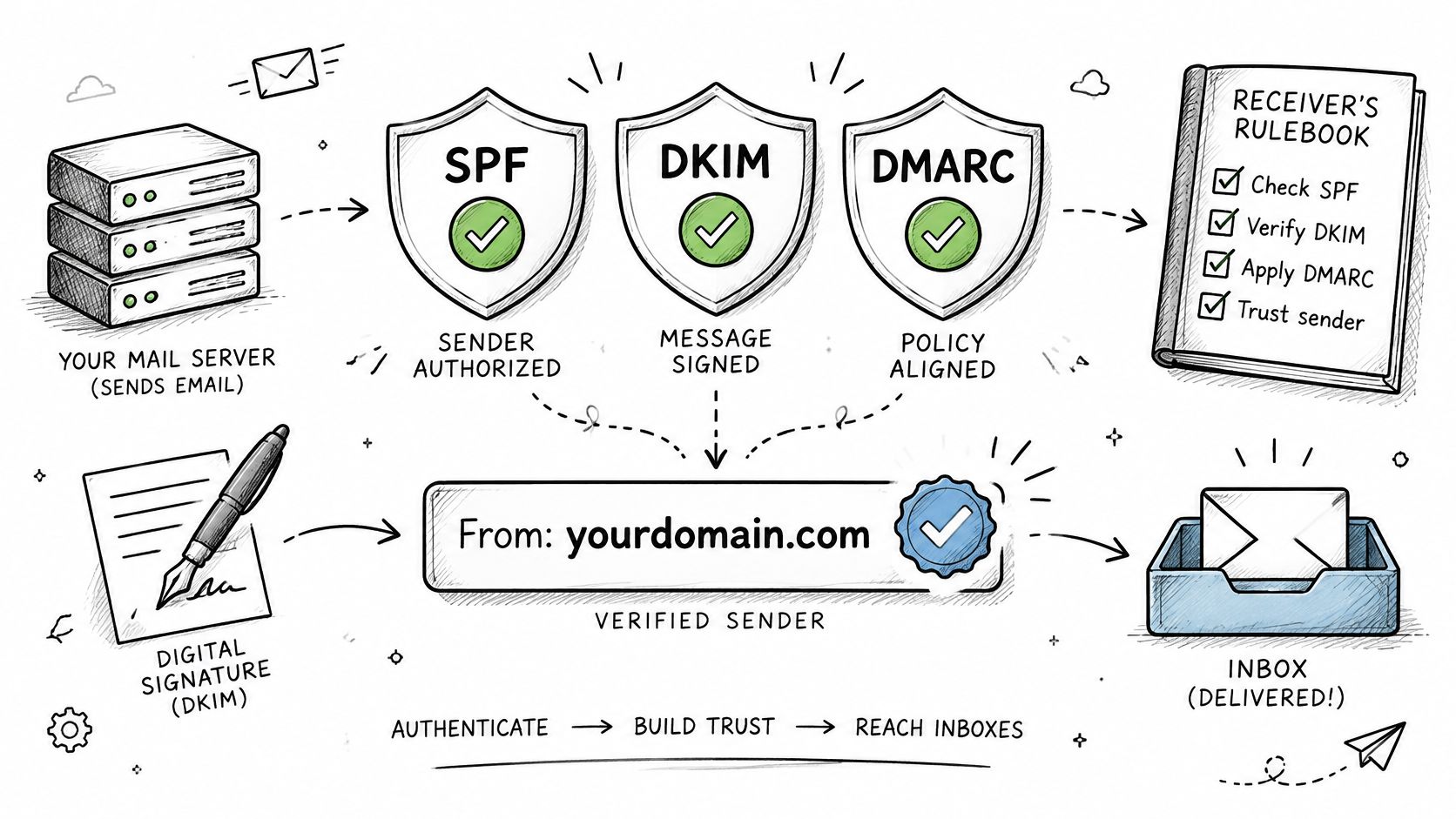
Three protocols, in plain terms. SPF lists the servers allowed to send for a domain. DKIM signs each message so a receiver can confirm it wasn't altered in transit. DMARC tells the receiver what to do when the other two fail, and reports back what happened.
Google's sender guidelines require all senders to configure at least SPF or DKIM, while senders approaching 5,000 messages per day to personal Gmail accounts must implement both SPF and DKIM plus DMARC. The part providers most often skip is From-domain alignment: the visible From domain must match either the SPF or the DKIM authenticated domain, or DMARC can't confirm the message wasn't spoofed or routed through an unauthorized identity.
The setup sequence that survives a real campaign
- Provision separate sending domains. Never your primary company domain. If a campaign damages reputation, you want the damage on a domain that exists for that purpose.
- Authenticate before volume. SPF, DKIM and DMARC on every sending domain, verified with a test send, not assumed.
- Create several mailboxes and warm them over weeks. A single mailbox carrying the whole campaign is a reputation bottleneck.
- Ramp with per-mailbox caps. Conservative daily limits, raised only when pass rates and replies hold steady.
- Monitor weekly and pause early. Authentication pass rates, bounces and complaints get reviewed every week. The mailbox with drifting numbers comes off rotation before it becomes a pattern.
Authentication alone doesn't buy inbox placement. Google also requires bulk senders to avoid unwanted email and make unsubscribing easy, which makes suppression-list hygiene, complaint monitoring and volume discipline causal parts of deliverability rather than paperwork. Our sending infrastructure is monitored alongside reply and booking rates, because the messages that matter are the authenticated, accepted and positively engaged ones, not the ones sent.
Ask two ownership questions before launch: who holds the domains and mailboxes, and do you keep them if you leave? If the answer is "we do", you're renting your reputation. Check your current setup with an email deliverability checker before the first campaign, and ask to see the provider's health dashboard, since deliverability problems stay invisible until replies fall.
Questions to Ask Before You Sign
Most buyers interrogate the price and skip the mechanics, which is like choosing a surgeon by the waiting-room furniture. Eight questions, each with the answer a provider who runs campaigns will give you.
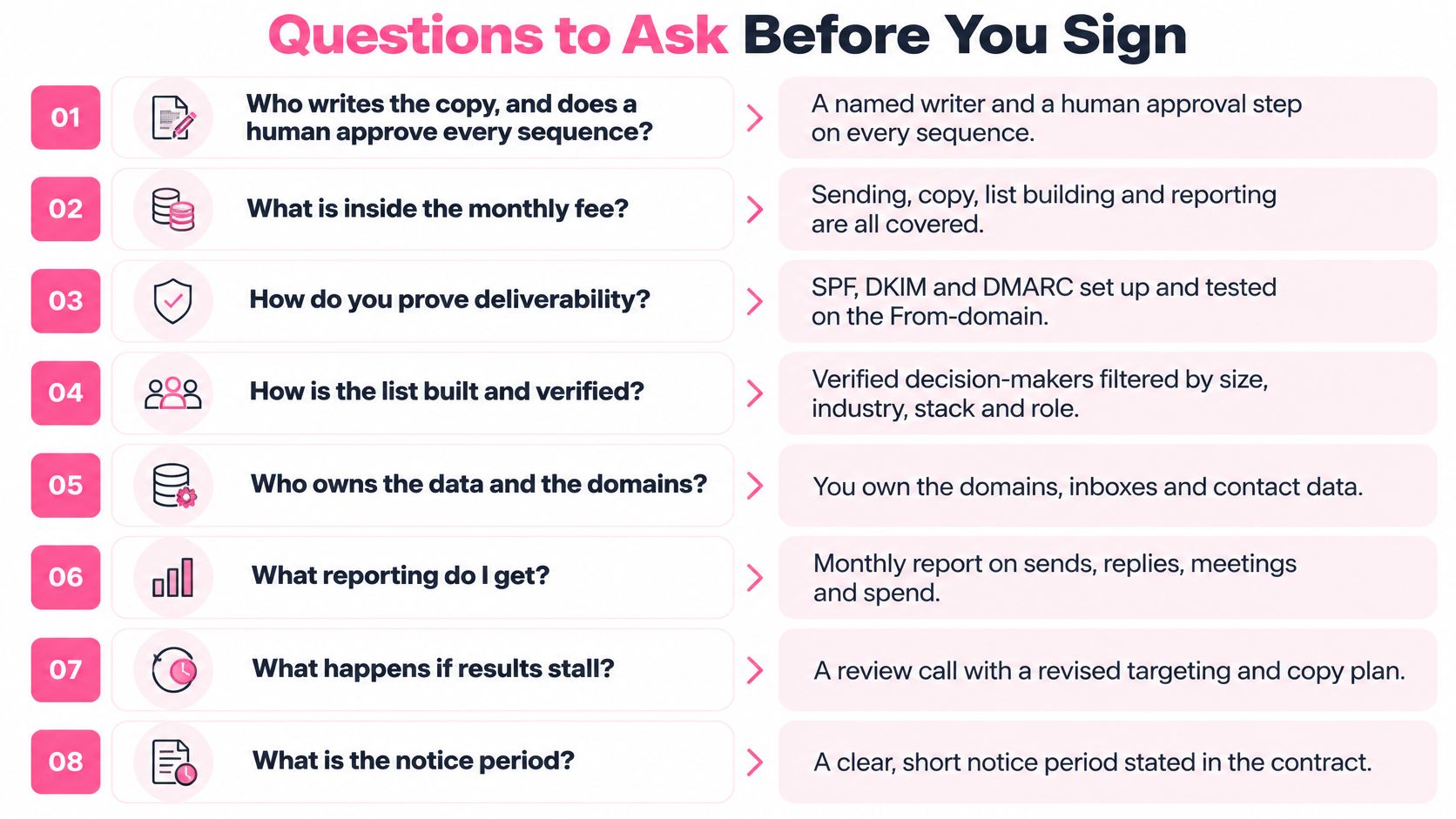
- Who writes the copy, and does a human approve every sequence? Strong answer: a named writer and an approval step on every sequence. Weak answer: "our AI."
- What's inside the monthly fee? The right list covers sending platform licences, domains, mailboxes, lead data and list sourcing, verification, enrichment and AI tooling. Ours are included in the monthly subscription, and if yours aren't, budget for a tooling invoice in month two.
- Who handles replies, and how fast? Look for a documented response window during staffed hours, in writing, with a number.
- How are opt-outs processed? The Federal Trade Commission's CAN-SPAM guidance requires a clear and conspicuous opt-out in every marketing email, honoured within 10 business days, with the mechanism working for at least 30 days after the message is sent and no fee or extra information demanded. Each separate violating email can carry a civil penalty of up to $53,088. Pay-per-close pricing doesn't shift that obligation to the provider. It stays with the sender.
- What counts as a qualified meeting, and who decides? Agree the definition before launch: role, company size, budget signal. A provider who says "anyone who takes the call" is booking activity.
- When is the commission triggered, and how is a closed deal verified? The trigger should be a signed deal or a payment received, visible in your CRM, not a promise in a monthly email.
- Can you see infrastructure health and live activity? A provider with nothing to hide shows campaign activity, replies and sending health without you asking twice.
- What happens if I pause? A short notice period, stated plainly, tells you nobody is relying on inertia.
One more thing to request: a sample campaign where positive replies were followed up promptly and booked straight onto the calendar. Watching that flow for thirty seconds explains more about a provider than their case study page.
How to Judge Results Beyond Opens and Lead Counts
| Metric | What It Shows | Benchmark or Threshold |
|---|---|---|
| Open rate | Attention from the inbox | 39.64% all-industry average in 2023; 44.72% for technology |
| Click-through rate | Initial response to the offer | 3.25% all-industry average; 7.40% for technology |
| Bounce rate | List and address hygiene | 2.33% all-industry average |
| Unsubscribe rate | Relevance of the message | 0.15% all-industry average |
| Spam complaint rate | Sender reputation | Keep below 0.1%; never reach 0.3% |
| Positive reply rate | Offer fit and intent | Judge against the segment's own first two weeks |
| Qualified meeting rate | Real buyer demand | Agreed in the contract before launch, per segment |
| Closed revenue per campaign | Commercial outcome | The number that decides renewal |
The email numbers come from GetResponse's 2024 email marketing benchmarks, which analysed 4.4 billion messages sent during 2023 by active senders with at least 500 contacts. Treat them as a baseline, not a target: they're cross-industry, not outbound-specific, and technology messages ran above average. The complaint thresholds come from Google's bulk sender requirements, where senders above a 0.3% spam rate lose mitigation options entirely.
Two readings of the same data
Strong opens with few meetings means a weak list or a weak call to action, and the list is the more common culprit. A lower-volume campaign aimed at decision-makers can beat a loud one on revenue while looking unimpressive in an opens dashboard. Neither open nor click proves sales-qualified demand on its own.
For a pay-per-close arrangement, the numbers that matter are closed deals and the commission they trigger. If a provider reports positive replies, qualified meetings and closed revenue, the first two explain the third. If they report only sends and opens, they're reporting effort.
Before you judge a campaign, check who your buyers listen to when they research. How SaaS influencer marketing works covers the peer and creator voices that shape a shortlist, which is useful context when your sequence is competing with a recommendation from someone the buyer trusts.
Pause rule: If complaints climb or positive replies fall for two weeks running, stop adding volume and inspect the list first. More sends on a broken list only accelerate the damage.
When replies start turning into calls, track what the meeting-ready leads look like, since a calendar full of the wrong job titles is the failure mode this entire scorecard exists to catch.
Outbound Versus Other Channels and In-House SDRs
| Channel | Your Control | Speed to First Meetings | Main Risk |
|---|---|---|---|
| Outbound service (pay-per-close) | Medium; you approve the offer and profile | Days to weeks once sending infrastructure is warm | Weak list or offer, and reputation damage |
| In-house SDR | High | Months, including hiring and ramp | Turnover and management load |
| DIY outbound | High | Weeks, after tooling and setup | Time cost and deliverability mistakes |
| Paid ads | Medium | Days once campaigns are live | Spend continues only while budget does |
| Content and SEO | Medium | Months to compound | Slow start and uncertain ranking |
Outbound wins on access. You pick the companies and the roles, you control volume, and a test cycle takes weeks rather than quarters. It also carries reputation risk, depends almost entirely on list quality, and interrupts people who didn't ask to hear from you.
Paid ads buy attention and stop the moment budget does. Content and SEO compound slowly, so the first qualified visit arrives months later. An in-house SDR gives you control and institutional knowledge, plus hiring, ramp time and management load before the first meeting. In 2025, 38% of larger companies with $250 million to $1 billion in revenue expected sales development representatives to generate 41% to 50% of total pipeline, according to Kondo's B2B Sales Benchmark & Technology Report. If you'd rather own the function than rent it, Hire SDRs is where that hiring route starts, and the comparison against hiring an SDR works through the arithmetic.
Ever Outbound is pay-per-close, so judge us on the same criteria as everything else in that table.
Verdict by situation: outbound wins when your ideal client profile is known and the offer is validated. It loses when product-market fit is unproven, or when nobody on your team can answer a positive reply the same day. Combine channels where you can. The best cold sequence usually points at a piece of content that does half the persuading on its own.
Run a 30-Day Pilot Before You Commit
Decide by situation first. A proven offer plus a team that answers replies within the working day means a pilot tests fit quickly. An unproven offer needs one small segment validated before you pay for volume. If you plan to hire SDRs eventually, pilot the outsourced version first so you learn what a good reply looks like before you write a job description.
- Agree the profile and two test segments in writing. Two, not six, so a weak result tells you something.
- Confirm authentication, per-mailbox caps and opt-out handling before the first send. Infrastructure that fails in week one poisons the whole test.
- Set success criteria you can verify. Positive reply rate, qualified meeting rate, meetings held and first closed deal.
- Review weekly and pause early. Any segment with climbing complaints or falling positive replies for two weeks comes off rotation.
- Decide on day 30 using closed revenue and commission owed. Not opens, not booked calls.
Keep the pilot to one channel and one offer, so a weak result identifies a variable instead of a mood. Record the list source, copy version and reply-handling time for each segment, because the day-30 review has to separate a targeting problem from an offer problem, and those have different fixes.
Every plan we run includes ideal client profile identification, offer creation, copywriting, sending infrastructure and warmup, prospecting, AI appointment setting, CRM setup, a real-time dashboard and one-to-one support, so the pilot covers the full chain rather than the list alone.
Ever Outbound Inc. runs done-for-you outbound for B2B SaaS companies on a pay-per-close basis: we build the verified list, write the copy, warm the domains, handle replies and book qualified calls onto your calendar, with plans from $97 a month plus 5% when a deal closes and your first two closes commission-free. If the test in this article is the one you want to apply, start with one segment and judge us on closed revenue rather than booked calls. Visit Ever Outbound Inc. to see how the pilot works.