October 20, 2026
Lead Generation for Consultants That Works
The most popular advice about lead generation for consultants is also the easiest to sell: personalize more emails, send more follow-ups, and ask everyone to book a call. It's a tidy recipe for a busy calendar. It isn't necessarily a recipe for clients.
A stronger approach starts with the decision your prospect is trying to make, then supplies the evidence they need to make it. Your outreach, public expertise, qualification process, and commercial model should all support that decision, not just manufacture another meeting.
Table of Contents
- Rethinking the Modern Consulting Pipeline
- Building Thought Leadership That Creates Demand
- Designing Outreach Around Buyer Decision Jobs
- Mastering Deliverability and Compliance Rules
- Qualifying Leads and Packaging Consultative Sales
- Measuring Pipeline Health Beyond Vanity Metrics
Rethinking the Modern Consulting Pipeline
Personalization isn't proof. Mentioning a prospect's recent promotion might demonstrate that you researched their profile, but it doesn't demonstrate that you can solve their business problem.
That distinction matters when buyers can investigate your expertise without replying. In a 2025 global survey of 350 B2B buyers from Responsive, nearly two-thirds used generative AI as much as or more than traditional search for vendor research, while 47% used AI for market research and discovery.
The traditional funnel leaves that independent evaluation out of the picture.

Make your expertise inspectable
Treat AI-discoverability as required trust infrastructure, not a promise that a chatbot will recommend you. Publish material that lets buyers and research tools understand whom you serve, what you do, and what evidence supports your claims.
- Specific service pages: Name the client problem, industry context, engagement scope, and relevant methodology.
- Defensible proof: Publish permissioned case studies, original research, and clearly explained results.
- Consistent descriptions: Use compatible language across your website, professional profiles, and third-party mentions.
Test visibility by asking relevant research tools to identify specialists for your actual niche. Record whether your firm appears, which sources get cited, and whether the description is accurate. Treat this as a diagnostic exercise, not an attribution system.
Practical rule: Before polishing an opening sentence, check whether a skeptical buyer can verify the expertise behind it.
For a wider planning reference, LiveDocument's consulting lead gen guide is a useful companion. When comparing execution options, inspect the responsibilities in this managed outbound workflow, particularly who handles research, replies, and qualification.
Better copy still matters. It just shouldn't be doing the work of an absent reputation.
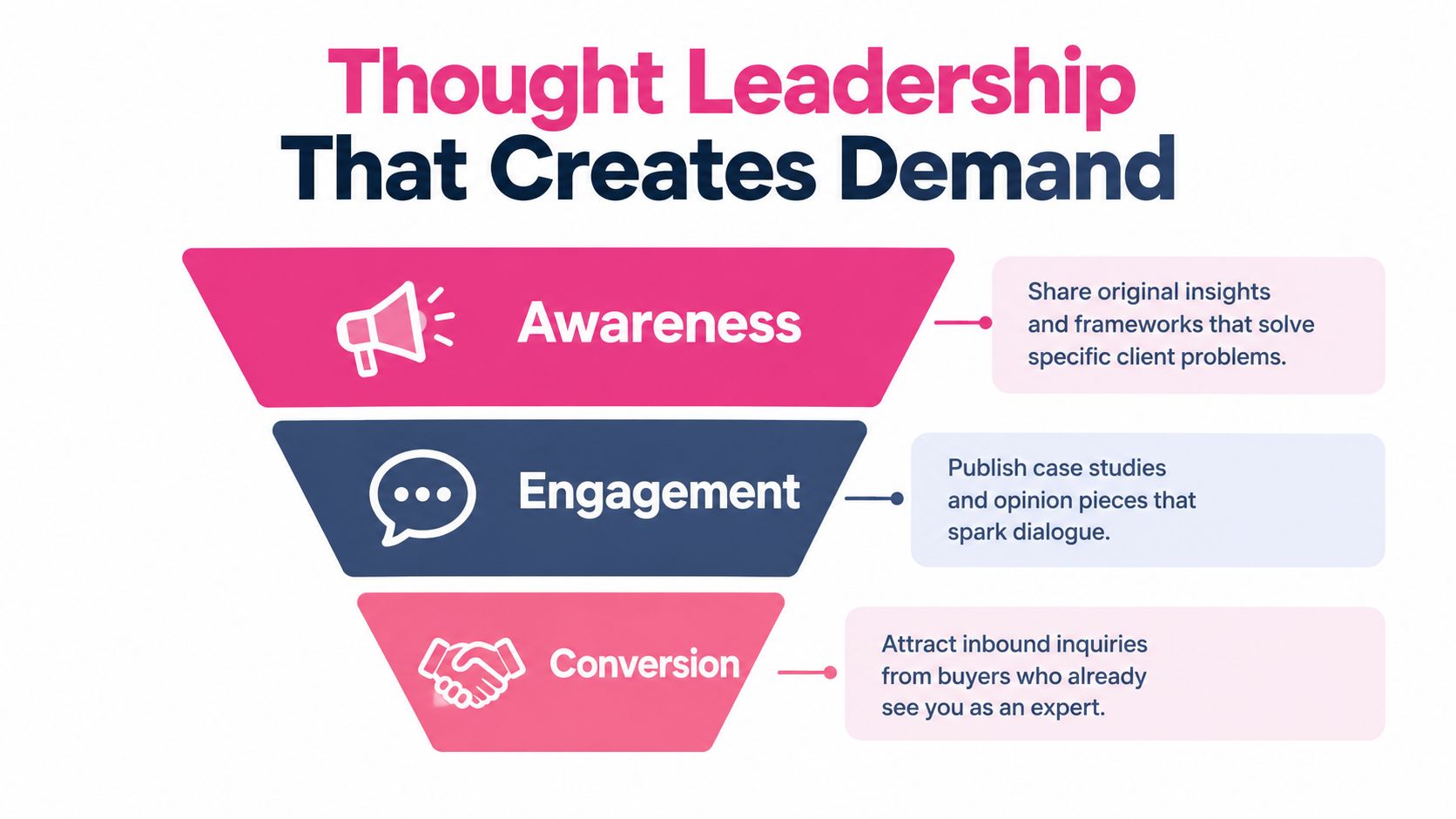
Building Thought Leadership That Creates Demand
A generic industry recap gives a buyer information. A useful diagnostic helps them recognize that their current approach might be wrong.
That's the distinction worth investing in. The 2024 Edelman-LinkedIn B2B Thought Leadership Impact Report found that 75% of decision-makers researched a product or service they hadn't previously considered after encountering a particular piece of thought leadership.
In the same report, 60% said strong thought leadership made them recognize a potentially missed business opportunity, while 70% said it caused them to question continuing with an existing supplier. Those findings support a different editorial ambition: don't just explain your services, help buyers reconsider their options.
Publish a tool for making a decision
Start with a recurring client question that requires judgment. An operations consultant might explain how to distinguish a staffing shortage from a broken handoff process. A fractional marketing leader might show how to assess whether weak pipeline comes from targeting, conversion, or sales follow-through.
Package the answer into something usable:
- Diagnostic framework: Explain what to inspect, what different findings mean, and when your method doesn't apply.
- Benchmark commentary: Show the source, comparison group, and limitations. Don't dress an educated guess as proprietary research.
- Executive argument: Challenge an expensive assumption and explain the circumstances in which you'd recommend another approach.
Narrareach's guide to how to grow with thought leadership offers another reference when choosing formats. Choose the format that best demonstrates your thinking, rather than the one that demands the most publishing.
Keep the commercial connection visible
A useful asset should make the next step obvious without withholding the useful part. Offer a worksheet, an assessment of the buyer's situation, or a discussion of the trade-offs your framework exposes.
There's a boundary, though. Publish enough to demonstrate judgment, but don't promise a bespoke consulting engagement disguised as a free consultation. A repeatable diagnostic is an acquisition asset. Unlimited unpaid analysis is a delivery problem wearing a marketing hat.
Designing Outreach Around Buyer Decision Jobs
Asking every prospect to book a call is like handing everyone the same prescription before asking what hurts. Some buyers haven't defined the problem. Others already have requirements and need evidence that you can deliver.
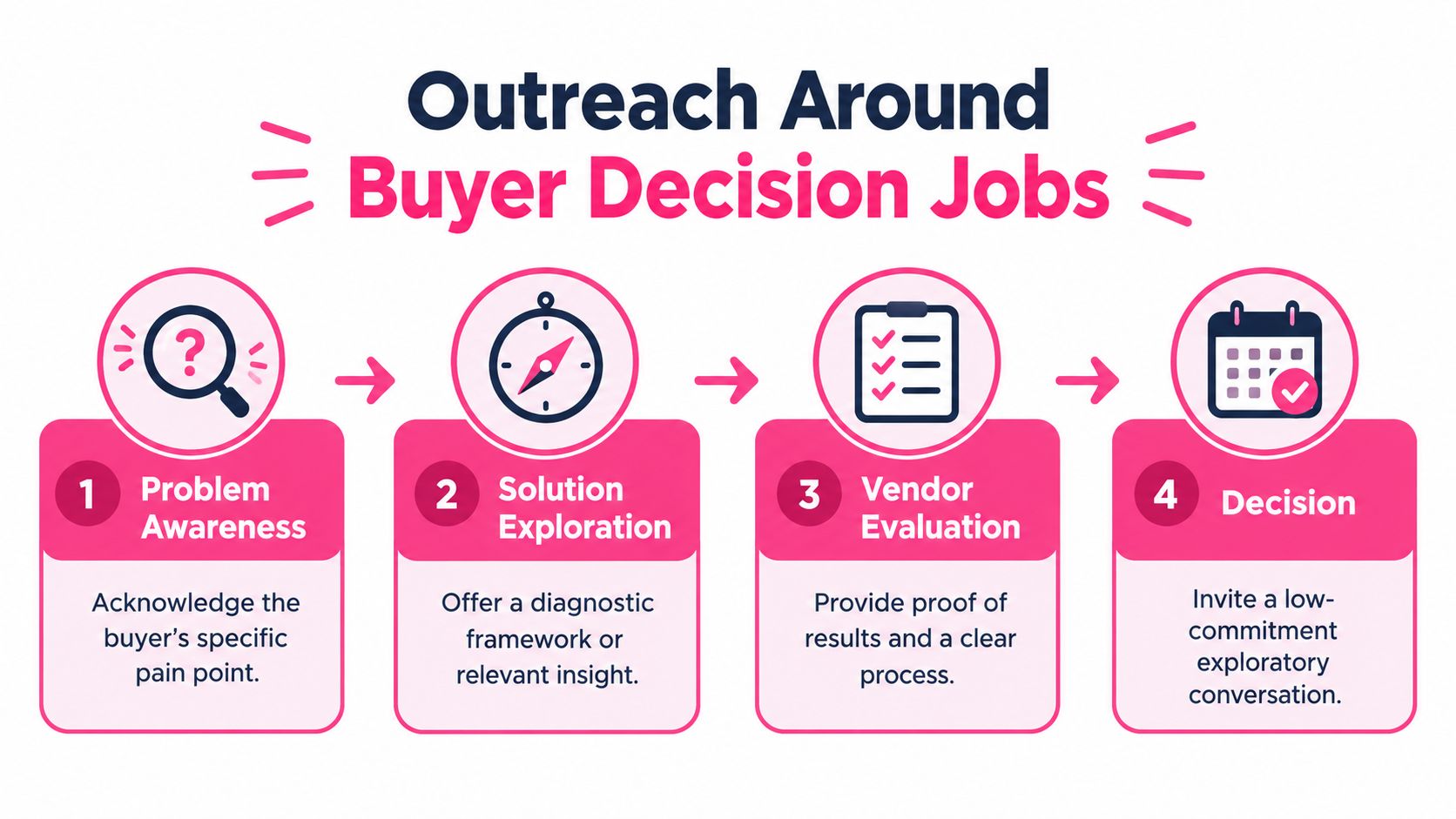
Gartner identifies four recurring B2B buying jobs: problem identification, solution exploration, requirements building, and supplier selection. Use those jobs to choose what you send, rather than assuming every contact is ready for a sales conversation.
Use the visual as an outreach overview, while keeping those buying jobs distinct in your CRM.
Match the offer to the unanswered question
| Buying job | What the buyer needs | Appropriate outreach offer |
|---|---|---|
| Problem identification | A way to recognize and describe the issue | Symptom checklist or diagnostic insight |
| Solution exploration | Help comparing possible approaches | Framework explaining options and trade-offs |
| Requirements building | Clarity on scope, constraints, and success | Requirements worksheet or evaluation criteria |
| Supplier selection | Evidence of fit and delivery capability | Relevant case study and methodology discussion |
Segment accounts by industry, size, observable trigger, and likely buying job. Treat the last field as a hypothesis, not a fact you can infer confidently from a job title.
For example, a leadership change might justify an offer to review inherited assumptions. It doesn't justify claiming that the new executive has a broken strategy.
Advance the conversation deliberately
Draft each follow-up around a useful addition, not another version of “checking in.” An email sequence generator can support drafting, but a human should verify the trigger, evidence, and appropriateness of the ask.
When someone replies positively, establish what they're trying to resolve, why it matters now, who participates in the decision, and what constraints apply. A request for your worksheet isn't permission to declare an opportunity qualified.
Use the accompanying video as a discussion prompt when reviewing your outreach approach.
The next step should answer a remaining buyer question. Sometimes that requires a call. Sometimes a concise document is the more useful response.
Mastering Deliverability and Compliance Rules
A convincing email that never reaches the recipient has no commercial value. Neither does an efficient follow-up system that keeps contacting people after they've opted out.
Treat technical delivery and lawful contact as launch requirements, not cleanup tasks. Permission to send, technical acceptance, and buyer interest are separate questions.
Know the thresholds and their meaning
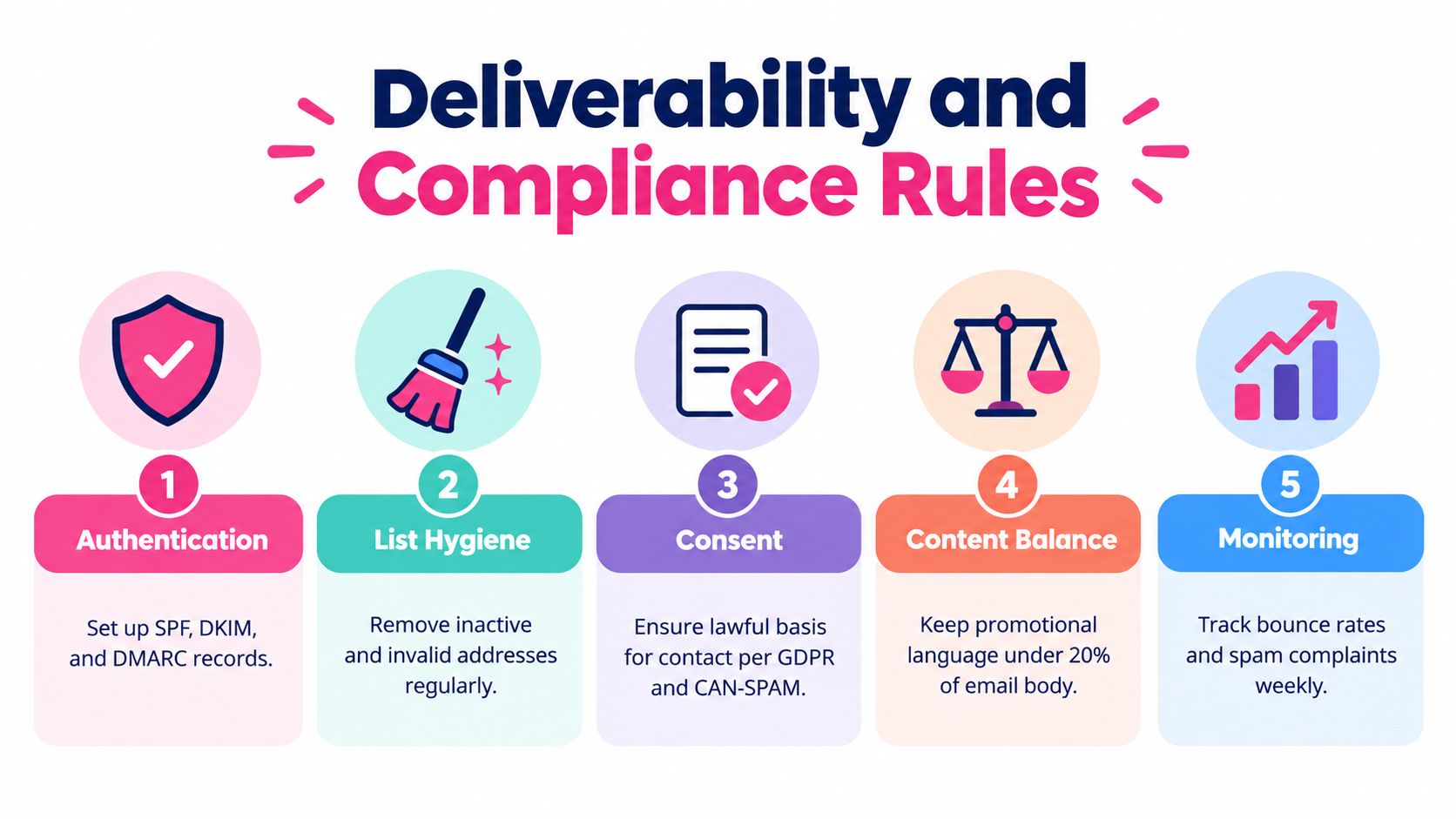
Google's sender guidance recommends keeping user-reported spam below 0.1% and preventing it from reaching 0.3% or higher. Bulk senders exceeding 5,000 messages per day to Gmail accounts face requirements including authentication and one-click unsubscribe for marketing messages; spam rates above 0.3% can make them ineligible for mitigation.
Those thresholds aren't interchangeable. Don't treat the higher threshold as a safe operating target, and don't use additional mailboxes to evade sender requirements.
Also, don't mistake the infographic's promotional-content ratio for a Google requirement. There's no universal copy-percentage shortcut to inbox placement.
Build controls into the workflow
- Before launch: Validate addresses, classify recipients, confirm applicable authentication requirements, and suppress previous opt-outs.
- During sending: Monitor bounces, complaints, and sending capacity. Use an email deliverability checker as a diagnostic aid, not an inbox guarantee.
- After a reply: Stop automated follow-ups when the recipient opts out, and synchronize that decision across active campaigns.
Under the FTC's CAN-SPAM guidance, opt-out mechanisms must work for at least 30 days after sending, and requests must be honored within 10 business days. Recipients can't be charged or required to provide personal information beyond an email address.
The ICO's direct-marketing guidance distinguishes corporate subscribers from sole traders and some partnerships. Unsolicited B2B email to corporate subscribers generally doesn't require PECR consent, but identification, opt-out handling, and applicable data-protection obligations still matter.
Operational standard: An unsubscribe is a suppression event, not an objection for your appointment setter to overcome.
Get market-specific legal advice when classification is uncertain. A verified address tells you that an inbox may exist, not that your campaign is lawful.
Qualifying Leads and Packaging Consultative Sales
A prospect who enjoys talking about strategy isn't automatically a buyer. If your discovery calls end with friendly enthusiasm and no defined next step, your qualification process needs attention before your calendar needs more bookings.
Use the conversation to establish the decision the buyer can make next. Don't spend the entire meeting touring your credentials.
Separate curiosity from commercial fit
Ask the buyer to describe the problem in their own terms, then investigate its consequences. What happens if they leave it unresolved? What have they already tried? Which internal constraints would prevent implementation even if your recommendation were sound?
Your CRM should distinguish:
- Urgency: A concrete reason to act, rather than general dissatisfaction.
- Authority: The decision owner and the people whose approval or participation matters.
- Requirements: Necessary outcomes, dependencies, exclusions, and constraints.
- Commercial fit: Whether the scope, timing, economics, and delivery expectations are compatible.
A contact without signing authority can still be valuable. The question is whether they can help establish a credible decision process, not whether their title passes an arbitrary seniority test.
Package the next decision
Don't jump from an exploratory conversation to a sprawling transformation proposal. Where uncertainty is material, offer a bounded diagnostic with explicit inputs, deliverables, responsibilities, and acceptance criteria.
| Buyer situation | Sensible response |
|---|---|
| The problem remains unclear | Define an assessment before proposing implementation |
| Requirements are taking shape | Help clarify scope and evaluation criteria |
| The buyer is comparing suppliers | Provide relevant evidence and a delivery plan |
| No credible path to action exists | Agree on an appropriate nurture step or disqualify |
Provide concise case studies and methodology documentation before asking stakeholders to approve work. Include quantified outcomes only when you can substantiate them, and explain the context that makes the comparison relevant.
For acquisition support, compare in-house execution, retainer agencies, and pay-per-close partners. Retainers pay for capacity regardless of sales outcomes; pay-per-close terms connect compensation to closed business, but still require clear attribution and commission definitions.
Use this qualification assessment to examine fit before choosing an execution model. Outsourcing appointment setting doesn't outsource your responsibility to scope well, sell, and deliver the engagement.
Measuring Pipeline Health Beyond Vanity Metrics
Consider a campaign review where the team celebrates rising opens while the consultant reports no worthwhile proposals. Nobody needs another subject-line brainstorm yet. They need to identify where interested contacts stop becoming credible opportunities.
Mailchimp's consulting-email benchmarks report 29.61% opens and 2.92% clicks. These are diagnostic reference points, not targets that establish whether your acquisition program is profitable.
Track progression with consistent definitions
Record delivered emails, qualified replies, qualified meetings booked, meetings held, opportunities, proposals, and closed revenue. Define each stage before comparing campaigns, and preserve the original source so referrals, content, and outbound don't all claim the same deal.
- Replies without qualified meetings: Inspect relevance, urgency, and the proposed next step.
- Bookings without attendance: Review expectations, scheduling friction, and confirmation messages.
- Held meetings without opportunities: Revisit targeting and qualification.
- Proposals without closes: Examine scope, proof, pricing fit, and stakeholder agreement.
These are investigation paths, not automatic diagnoses. Review actual conversations before rewriting the campaign.
A crowded calendar can still hide an empty pipeline. Count what buyers commit to, not just what they click.
Forecast from your own conversion history
Calculate expected closed-revenue value as:
Qualified meetings booked × show rate × opportunity rate × average contract value × close rate
Use compatible denominators: opportunity rate should refer to held meetings, and close rate to opportunities. Keep gross opportunity value separate from this probability-weighted revenue estimate.
Include research, infrastructure, acquisition fees, and your own sales time when evaluating costs. An outreach ROI calculator can help organize assumptions; for another measurement reference, see how Legacy Builder measures leads.
Scale when qualified progression, delivery health, and consulting capacity support it. Sending more before those conditions hold just gives you a larger spreadsheet to explain.
At Ever Outbound Inc., we're pay-per-close, offering done-for-you B2B client acquisition through human-led research, outreach writing, managed sending infrastructure, and appointment setting. Visit us to discuss a consulting campaign built around qualified buyer conversations and closed business, rather than raw lead counts.