October 27, 2026
Introduction Sales Email Templates: 7 Examples to Adapt
Say you're a founder scanning 40 unread messages at 8:15 a.m., coffee in hand, with three seconds to decide whether a stranger deserves your attention. One sender congratulates you on your company's impressive journey. Another notices you're hiring outbound reps and asks whether those reps will inherit a tested offer or have to build one themselves.
You probably know which email survives.
A good introduction sales email answers why are you emailing me? before the prospect has to ask. It doesn't need a dazzling opening line. It needs a believable reason for showing up, a problem the recipient recognizes, and a reply that won't turn into an unpaid homework assignment.
The tricky part comes after the open. Your prospect is deciding whether you understand their situation, whether your claim deserves trust, and whether answering will unleash a calendar invitation they never wanted.
The inbox test: Read your email as the recipient. Can you explain why it matters without supplying information the sender forgot to include?
The seven approaches below start with different reasons someone might care: their news, their pain, a mutual contact, a useful insight, an operational trigger, relevant proof, or a specific question. Each includes adaptable copy, a look at what replying costs the reader, and the point where a promising approach becomes another pitch to delete.
Table of Contents
- 1. Personalized Research-Based Introduction
- 2. Problem-Agitate-Solve (PAS) Introduction
- 3. Referral or Mutual Connection Introduction
- 4. Insight-Led Value Introduction
- 5. Trigger-Event Introduction
- 6. Case-Study Social Proof Introduction
- 7. Question-Led Introduction and Multi-Touch Sequence Opener
- How the seven introduction sales email approaches compare
- Pick One Template Tonight and Send It Tomorrow
1. Personalized Research-Based Introduction
A founder announces funding. Their careers page lists new sales roles. You connect those public facts to a practical question about pipeline, rather than sending congratulations with a sales brochure attached.
Subject: Your Series B and the outbound hiring push
Hi Morgan,
Congrats on the Series B. Saw you're hiring SDRs, which made me curious about the messaging they'll inherit.
I help revenue teams test outbound offers before new reps start prospecting. Would seeing a sample testing plan be useful?
The recipient can understand why you picked them. They can also answer without opening their calendar, explaining their sales process, or admitting anything is broken.

Make the observation earn its place
In a field experiment involving 7,000 B2B prospects, recipient-plus-company personalization produced a 26.17% open rate, compared with 20.11% for industry-only personalization, according to Corporate Visions' personalization study. That supports relevant context, not a scavenger hunt through someone's personal life.
For an HR-tech prospect, another opening might be: Your new Gusto integration caught my eye. Is explaining the financial case to buyers part of the rollout? The useful detail is the integration, and the commercial connection is buyer understanding.
- Keep research bounded: Spend a few minutes checking funding, hiring, launches, and public content.
- Verify the detail: Confirm the announcement date, product name, and recipient's responsibility.
- Connect it to work: Replace praise with a plausible operational question.
Public professional activity can also help you coordinate LinkedIn outreach without repeating the same message across channels.
At Ever Outbound, we're pay-per-close, so you pay 5% only on deals you close, with your first 2 closes commission-free. Our human researchers verify prospect context before writers turn it into a personalized first touch.
Where it backfires: An old announcement, incorrect role, or irrelevant compliment makes the research feel like a mail-merge costume. If the observation doesn't change your offer, leave it out.
2. Problem-Agitate-Solve (PAS) Introduction
The agency owner opens your email between delivery calls. You have room to name the problem, not diagnose their entire business from the sidewalk.
Subject: Pipeline when delivery gets busy
Hi Jamie,
Does new-business outreach tend to pause when client delivery gets busy?
When the founder owns both, prospecting can slip until the next project finishes. We build outbound campaigns for B2B agencies so follow-up doesn't depend on a gap in the founder's diary.
Is that a gap you're trying to close?
This Problem-Agitate-Solve introduction works when the recipient recognizes the situation. The agitation is the operational consequence, not a theatrical prediction that their agency will collapse by Friday.
Describe the problem without announcing a diagnosis
Use language prospects already use in discovery calls, reviews, and professional forums. An MSP might talk about renewal conversations getting pushed back, while an agency founder describes a feast-or-famine pipeline.
For that MSP, try a different version:
Subject: Renewal conversations getting pushed back
Hi Taylor,
Do renewal-planning conversations ever get delayed behind urgent support work?
We help MSPs organize outreach to decision-makers before those discussions become last-minute negotiations.
Would seeing the outreach structure be useful?
The recipient can confirm relevance without revealing churn figures or defending their team. If you have a verified result from a comparable client, add it to the solution sentence. Don't manufacture a proof point to complete the formula.
Before sending, use the cold email grader to inspect clarity, then read the draft aloud for tone. Software can flag problems; you still need to decide whether you sound helpful or smug.
Where it backfires: Your prospect may already have a reliable process. State the pain as a question or hypothesis, not a fact about their company.
Test alternative problem statements while keeping the offer and audience stable. Otherwise, you won't know whether buyers rejected the problem, the solution, or the wording.
3. Referral or Mutual Connection Introduction
Dana's name appears in Priya's inbox. Priya recognizes it, opens the email, and expects the connection to mean something.
That expectation is useful. It's also easy to abuse.
Subject: Dana suggested I reach out
Hi Priya,
Dana Whitfield mentioned you're rebuilding your revenue team's outbound motion and suggested we speak.
I help B2B SaaS teams develop outbound messaging around their target buyers' priorities. Would it be useful if I sent a relevant example before we consider a call?
This hypothetical introduction gives Priya the relationship, the reason, and a low-effort next step. Use that wording only if Dana actually suggested the conversation.

Borrow context, not an endorsement
A mutual contact isn't automatically a referrer. Being connected to Marcus on LinkedIn doesn't justify a subject line claiming an introduction from Marcus.
If Marcus merely identified the right person, write: Marcus at Northwind mentioned you oversee cybersecurity training for the sales organization. That's accurate, useful context without an invented recommendation.
- Get permission: Confirm that you can use the contact's name.
- Confirm the wording: Ask what they suggested and what context you can share.
- Close the loop: Thank the referrer after the conversation without sharing confidential details.
For the recipient, the reply costs more than typing time. They may feel a social obligation to someone they know, so give them a comfortable way to decline.
Where it backfires: The connection is distant, the context is outdated, or the email implies private information was shared without permission. A warm-looking subject line can quickly become an awkward conversation between your prospect and your supposed referrer.
When the relationship is genuine, ask the contact whether they'd prefer to introduce you directly. Give them a concise, accurate description they can forward, not a glowing recommendation they'd have to edit down.
4. Insight-Led Value Introduction
An agency founder doesn't necessarily need another meeting. A useful way to inspect their current outbound offer might be more welcome.
Subject: An offer-clarity teardown for agency outbound
Hi Jordan,
A useful test for an outbound opening is whether the buyer can identify the problem you solve without reading your service list.
I've put together a short teardown showing how to make that connection clearer in agency outreach.
Want me to send it?
This template assumes the teardown exists. Create the resource before offering it, and make sure the recipient can use it without buying anything.
Bring something they can use without you
The prospect's first reaction should be practical curiosity, not suspicion that a downloadable checklist requires a discovery call. A simple reply should get them the promised resource.
A reported Belkins analysis of 16.5 million cold emails across 93 business domains put average cold-email replies at 5.8% in 2024, down from 6.8% in 2023, as summarized by Gaidme's benchmark review. If you use that finding in outreach, preserve its scope rather than presenting it as the prospect's expected performance.
For an MSP audience, offer a new-client discovery checklist that helps identify unclear responsibilities before onboarding. For a revenue leader, a model built with a cold email ROI calculator can make campaign assumptions easier to inspect.
Give them something useful even if their next decision is to handle the problem internally.
Where it backfires: The insight is obvious, the resource is stale, or the free offer turns out to be a gated sales presentation. You've asked for trust and delivered a detour.
Review time-sensitive insights regularly. Cite statistics with their publisher and reporting period, and distinguish measured findings from your own recommendations.
Once the prospect asks for the resource, send it with a short explanation of what to look for. Don't make them chase the thing you volunteered.
5. Trigger-Event Introduction
A new CRO starts work. Vendors descend with congratulations, strategy offers, and suspicious certainty about what the executive needs.
Your introduction sales email needs a better reason to arrive than the job announcement alone.
Subject: Outbound messaging after the leadership change
Hi Avery,
Saw you've joined as CRO. If reviewing the inherited outbound offer is on your agenda, I can share a testing-plan outline.
It separates audience, offer, and messaging decisions so the team can inspect them individually.
Would that be useful while you're setting priorities?
The executive can place the offer in their current workload. You haven't declared that their predecessor left a disaster behind.
Explain why now without inventing urgency
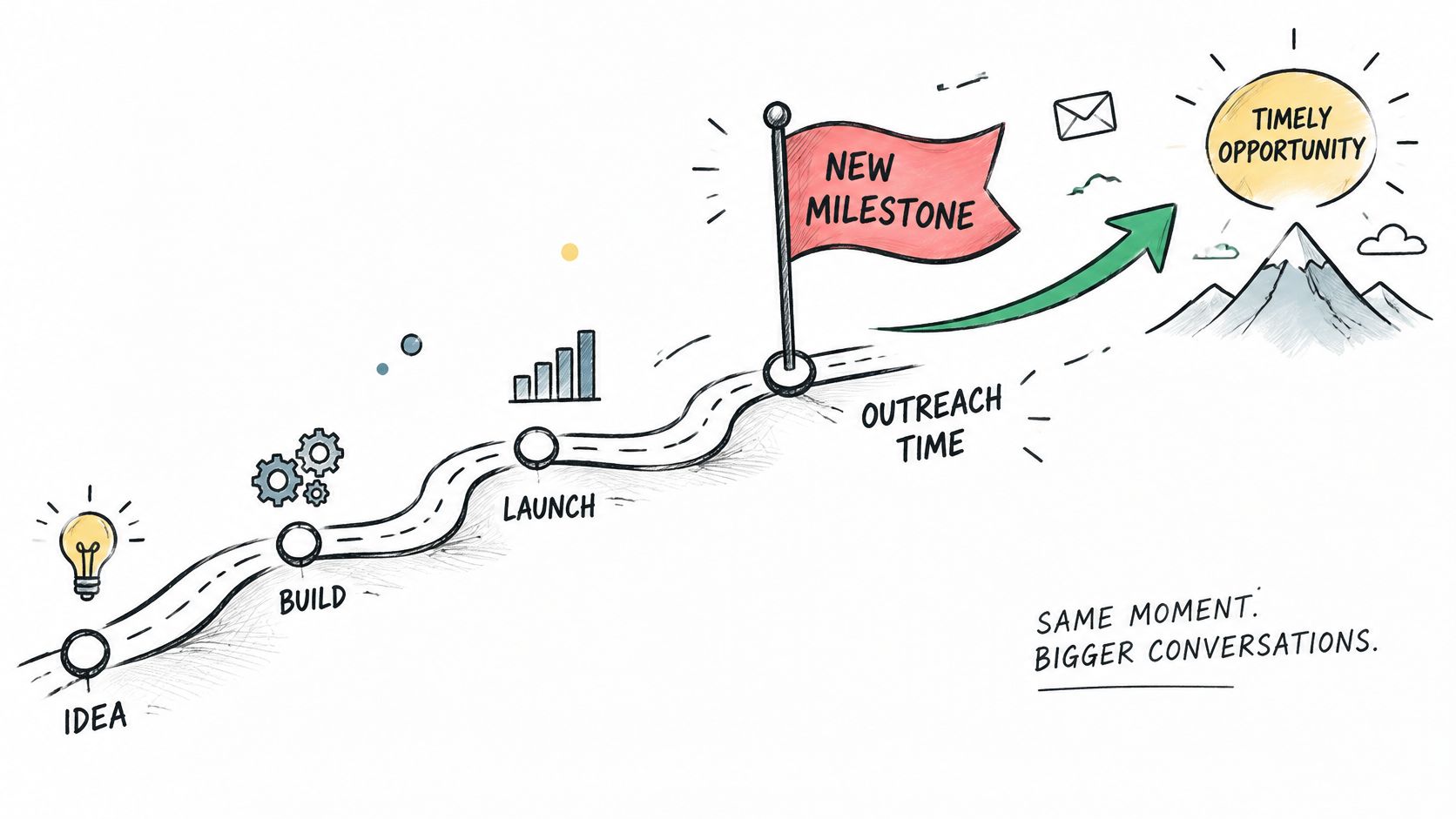
Research-based personalization answers why this company. A trigger-based introduction also answers why this moment.
Consider a consultancy announcing expansion into healthcare:
Subject: Your move into healthcare clients
Hi Casey,
Saw the announcement about your move into healthcare consulting. Are you validating a new offer for that market, or taking an existing service into a new buyer group?
I help consulting teams structure outbound tests around that distinction. Happy to share an example if useful.
Set alerts in Google Alerts and monitor company newsrooms, leadership announcements, and relevant hiring activity. Verify the event before referencing it, then connect it to a decision the recipient might actually own.
- Funding: Ask about a relevant execution priority, not assumed spending power.
- New leadership: Offer help evaluating inherited processes.
- Market expansion: Connect your offer to buyer research or message validation.
Where it backfires: A trigger doesn't prove intent to buy. A funding announcement isn't an invitation to spend, and a new executive may still be learning names.
Keep the reply inexpensive. Asking whether a planning outline would help is easier to answer than requesting a strategy session during someone's first week.
6. Case-Study Social Proof Introduction
A consultant reads a vendor's promise to generate more pipeline. Fine. Everyone promises that.
A comparable client's documented result gives them something more concrete to inspect.
Subject: Outbound for a sales consultancy
Hi Alex,
Merci Beaucoup Consulting, a sales and business development consulting firm, got 30 meetings and 3 contracts in 5 weeks through our work at Ever Outbound, where we're pay-per-close.
Is creating another route to qualified conversations a priority for your firm?
I can send the case summary if it's relevant.
The question isn't whether the result looks impressive in isolation. It's whether the recipient sees enough similarity to justify learning how it happened.
Match the situation before the headline
A consultancy may care about another consultancy's route to meetings. An MSP may care more about reaching IT decision-makers before renewal planning. Match the case to the recipient's business model, buyer, and problem, not just their broad industry label.
Use the client results and case studies to inspect relevant examples. For building your own evidence, Pure Write's case study writing guide is a useful starting point.
Your email needs a compact account of the starting situation, what changed, and the documented outcome. The full case study can carry the explanation of targeting, offer, execution, and limitations.
Proof has a boundary: A result shows what happened in a particular engagement. It doesn't promise the same outcome for the next company.
Get permission before naming clients or sharing sensitive details. Anonymizing a case can protect confidentiality, but don't remove so much context that the prospect can't judge comparability.
Where it backfires: The result is real but irrelevant, or the email omits the circumstances that produced it. A buyer shouldn't need a magnifying glass to discover that your example involved a completely different offer.
Keep the initial ask focused on relevance. Send the full evidence when requested, and be ready to explain the work behind the headline.
7. Question-Led Introduction and Multi-Touch Sequence Opener
A good question lets the prospect answer from memory. A bad one makes them feel they've accidentally opened a consulting questionnaire.
Subject: First meetings beyond referrals
Hi Ravi,
I help agencies develop outbound offers. Are referrals still your main source of first meetings, or do you have an active outbound channel alongside them?
Happy to share a relevant example if you're evaluating that mix.
Ravi can answer in a line. He knows who you are and why you're asking.
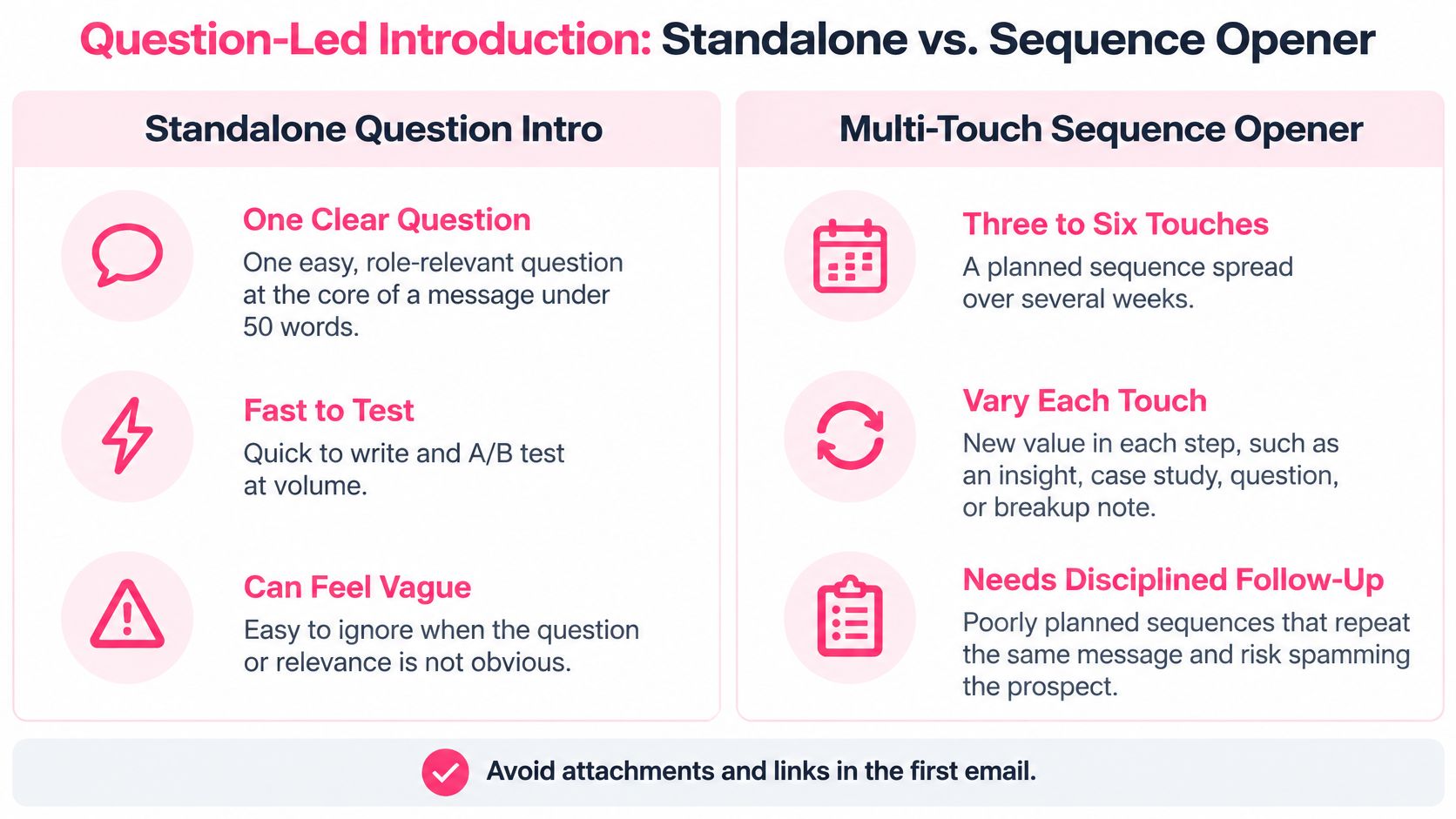
Choose whether the question stands alone or begins a planned sequence before you send it.
Plan the next touch before the first
An alternative opener might tell Sam you noticed the move into the mid-market, explain your work testing outbound offers, and offer a relevant example. Don't promise an inbox series nobody subscribed to.
In a large observational test, Sales.co's personalization analysis reported that the first message generated 69% of all replies. That's a reason to strengthen the introduction, not compensate for a weak one with endless reminders.
Build a limited sequence with the email sequence generator, then review each touch for real new value.
- No reply: Add a useful insight or comparable case, not another demand for attention.
- Active interest: Answer the question and agree on a next step.
- Another channel fits: Add context through LinkedIn or phone without duplicating the pitch.
- Negative intent: Stop, suppress the contact, and respect opt-outs across channels.
For a walkthrough to accompany your sequence planning:
At Ever Outbound, we're pay-per-close, with a 5% commission only on closed deals and your first 2 closes commission-free. We manage multi-step sequences with domain pools, warmup, and daily sending controls.
Where it backfires: The question requests sensitive information, reaches the wrong role, or conceals a meeting pitch. Keep it specific, answerable, and honest about your commercial purpose.
How the seven introduction sales email approaches compare
| Item | Research Required | Typical Length | Best For | Main Risk |
|---|---|---|---|---|
| Personalized Research-Based Introduction | Moderate; verify a recent prospect-specific detail | 3–5 short sentences | Relevant outreach to busy decision-makers | Stale or shallow details can damage trust |
| Problem-Agitate-Solve (PAS) Introduction | Moderate; identify a specific, relevant pain | Usually under 100 words | Prospects who already feel the problem | Agitation can feel manipulative or assume a pain that is not present |
| Referral or Mutual Connection Introduction | Low to moderate; confirm the connection and get permission | Short, a few sentences | Warm outreach through a credible mutual contact | Misrepresenting the referral can harm relationships |
| Insight-Led Value Introduction | High; source or develop a credible insight | Short, with an optional ask | Executives and skeptical buyers | Unsupported or generic insights undermine credibility |
| Trigger-Event Introduction | Moderate; monitor and verify a timely business event | Short and timely | New leaders or companies facing a recent change | The trigger window can be brief |
| Case-Study Social Proof Introduction | Moderate; verify results and obtain permission to share | 2–3 sentences for the case study | Buyers seeking proof from comparable customers | Results may seem guaranteed or not apply to the prospect |
| Question-Led Introduction and Multi-Touch Sequence Opener | Low for a single email; planning required for a sequence | Often under 50 words; sequences typically use 3–6 touches | Fast, low-friction outreach and structured follow-up | Vague questions or repetitive follow-ups can feel like spam |
Pick One Template Tonight and Send It Tomorrow
Open your prospect list and choose a segment narrow enough to share a recognizable problem. Agencies whose founders still own new business need a different opening from SaaS teams hiring their first outbound leader.
Choose the approach that matches your reason for contacting those people. Use research when you have a meaningful observation, a trigger when timing matters, a referral when the connection is genuine, and proof when you have a comparable result.
Then add a verified detail and read the message aloud. If you sound like a brochure wearing a name badge, simplify it. Using voice typing for email can help you draft a more conversational opening, provided you check names, claims, and punctuation afterward.
Make the test small enough to learn from
Send a small test batch, keep the audience and offer consistent, and review replies after two weeks. Treat that as a learning window, not a universal deadline for declaring a campaign successful.
Separate positive replies, referrals, objections, uninterested replies, bounces, and booked meetings. An irritated response isn't evidence that your messaging worked, and silence doesn't tell you whether the problem was targeting, delivery, timing, or copy.
- Relevant interest: Identify which problem or resource prompted the response.
- Wrong-person replies: Correct role targeting before polishing sentences.
- Repeated objections: Revisit your offer and assumptions.
- Delivery problems: Pause expansion while you inspect sending infrastructure.
Compliance belongs in this review too. The FTC's CAN-SPAM compliance guide requires truthful sender information, non-deceptive subjects, clear advertising identification, a valid postal address, and an opt-out method for covered commercial email, including individually sent messages.
Authentication and reputation matter alongside the copy. Google's sender guidelines require bulk senders to use SPF, DKIM, and DMARC and keep reported spam rates below 0.30%; domain pools don't remove those responsibilities.
If you'd rather hand off research, copywriting, and follow-up, Ever Outbound, we're pay-per-close, builds verified lists and personalized outreach, then books interested prospects onto your calendar. You only pay a 5% commission on deals you close, with your first 2 closes commission-free.
Tonight, pick the segment and draft the email. Tomorrow, verify the details, check the sending setup, and launch the small test. Your prospect doesn't need your most elaborate introduction. They need a clear reason to care and a comfortable way to respond.
At Ever Outbound Inc., we're pay-per-close, and our human-led team handles prospect research, introduction sales emails, follow-up, and qualified appointment booking. Visit us to discuss an outbound campaign for your market, with a 5% commission only on deals you close and your first 2 closes commission-free.