November 8, 2026
Ideal Customer Profile Template: 10 Worth Filling Out
A popular workshop line says you already know your buyer, so grab any ideal customer profile template, fill the boxes from memory, and start outbound on Monday. I don't buy it. A blank worksheet completed from opinions is worthless. It records what the room believes, not which accounts buy, stay, and pay. The value sits in templates that force interviews, closed-won patterns, and fields you can turn into searches, scores, and stop rules.
Ten templates sit below. Each one is reviewed for what it helps you do after you fill it out, who it fits, and where it annoys you. Ignore the prettiest layout. Pick by how far along your team is with customer data. A founder with a short customer list needs interview prompts. A revenue team with a CRM needs a scorecard. A leadership meeting that only wants a poster can use a design file, then keep that file out of the targeting stack.
If your best customers cluster in one vertical and your closed-lost deals cluster in another, write that split down before you touch a filter. Treat the template as the starting line for outbound targeting, not the finish. Industry and headcount without a trigger, a disqualifier, and a named buyer still produce a tidy list of people who will ignore you.
Table of Contents
- 1. Close - Ideal Customer Profile Kit
- 2. HubSpot - Ideal Customer Profile Template
- 3. Smartsheet - B2B Ideal Customer Profile and Scorecard Templates
- 4. Miro - Ideal Customer Profile Templates
- 5. Cognism - ICP Guide and Template
- 6. Apollo - ICP Guide and Quick Template
- 7. Qualtrics - Ideal Customer Profile Template
- 8. Notion - Appolica Ideal Customer Profile Template
- 9. Canva - Customer Profile Templates
- 10. Salesforce - Ideal Customer Profile Guidance and Persona Templates
- 10 Ideal Customer Profile Templates at a Glance
- Fill It Out, Then Point It at Real Prospects
1. Close - Ideal Customer Profile Kit
Close's Ideal Customer Profile Kit is the file I hand a team that already has customers and still targets "companies like us." It's free, built for B2B, and pairs downloadable worksheets with a research checklist and customer survey questions. You capture firmographic, technographic, behavioral, and psychographic traits, then you're expected to push those findings into targeting, messaging, lead scoring, and qualification. Google Sheets or Excel means nobody has to adopt a new app just to write the profile down.
The homework matches how a serious profile should start. Build from a set of closed-won customers, segment by retention and lifetime value, and let the top-performing quartile set the first empirical profile instead of a hunch, as laid out in the Real Growth Matters ICP guide.
What works: the checklist stops a brainstorm from counting as research, and the fields map cleanly onto outbound prospecting.
Where it falls short: download access may ask for contact details, and the guidance stays thin if your CRM is empty.
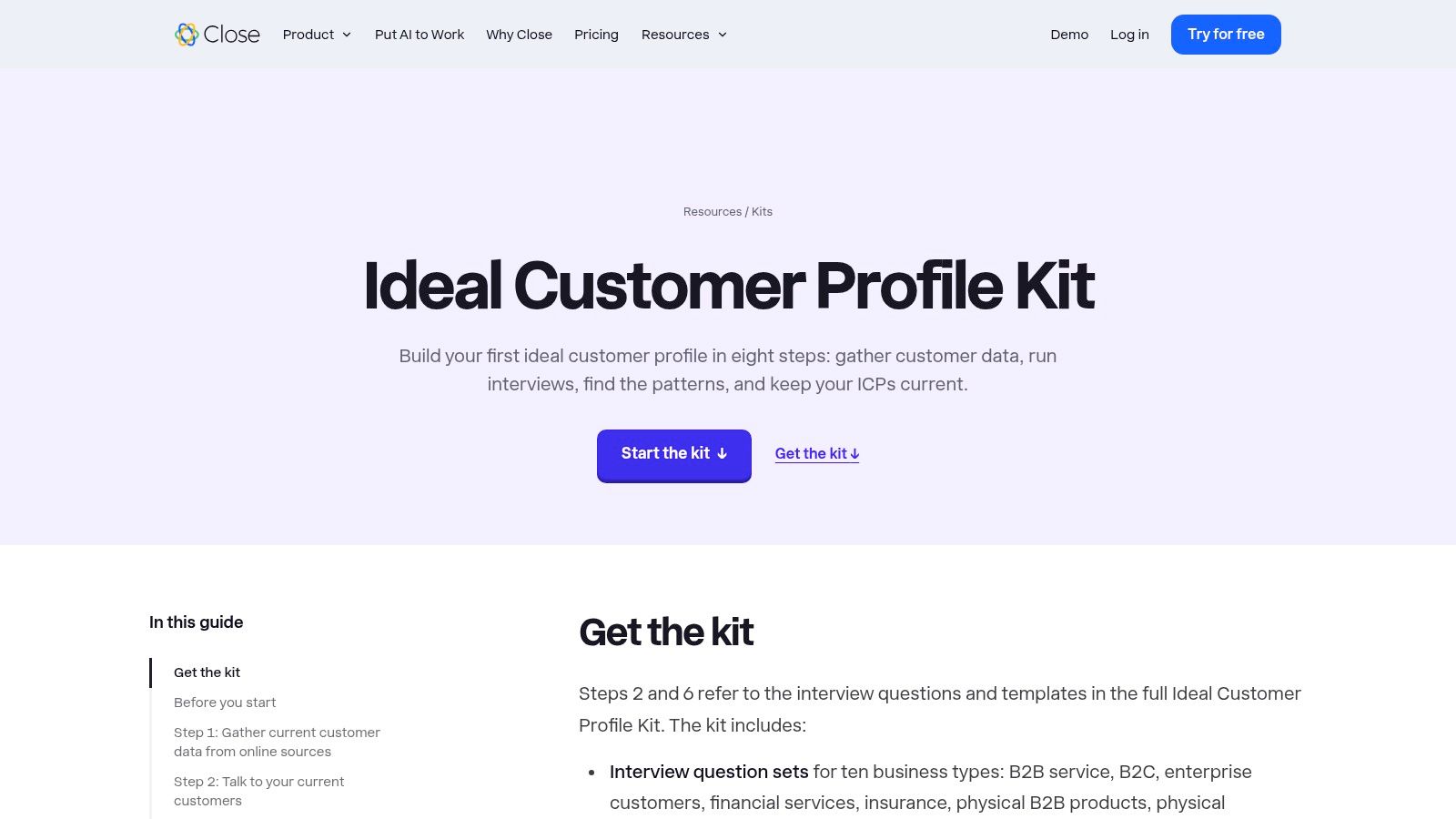
The kit's resource page looks like this.
Once the fields are backed by customers, run them through account qualification before a name hits a sequence. Grab the Close ideal customer profile kit when you can interview customers this month.
2. HubSpot - Ideal Customer Profile Template
HubSpot's guided tool gives you a starting structure rather than a blank page. Prompts cover goals, challenges, responsibilities, and communication preferences, with examples for B2B, B2C, and small-business audiences. Those examples help clarify what a specific pain point looks like.
The trade-off is that some prompts describe a person, not an account. Buyer preferences and company fit answer different questions, so don't treat a completed persona as a usable prospecting filter. A Customer Impact summary reports that roughly half of marketers lacked a formally documented ideal customer profile. A polished profile still needs to be checked against customer evidence.
Treat the generated profile as a draft. Check each claim against closed-won and closed-lost accounts before using it to build a list.
Best for: teams creating a first profile who want to pair company criteria with a buyer perspective.
Annoying bit: access may depend on an account or form, and persona fields won't filter a prospect database.
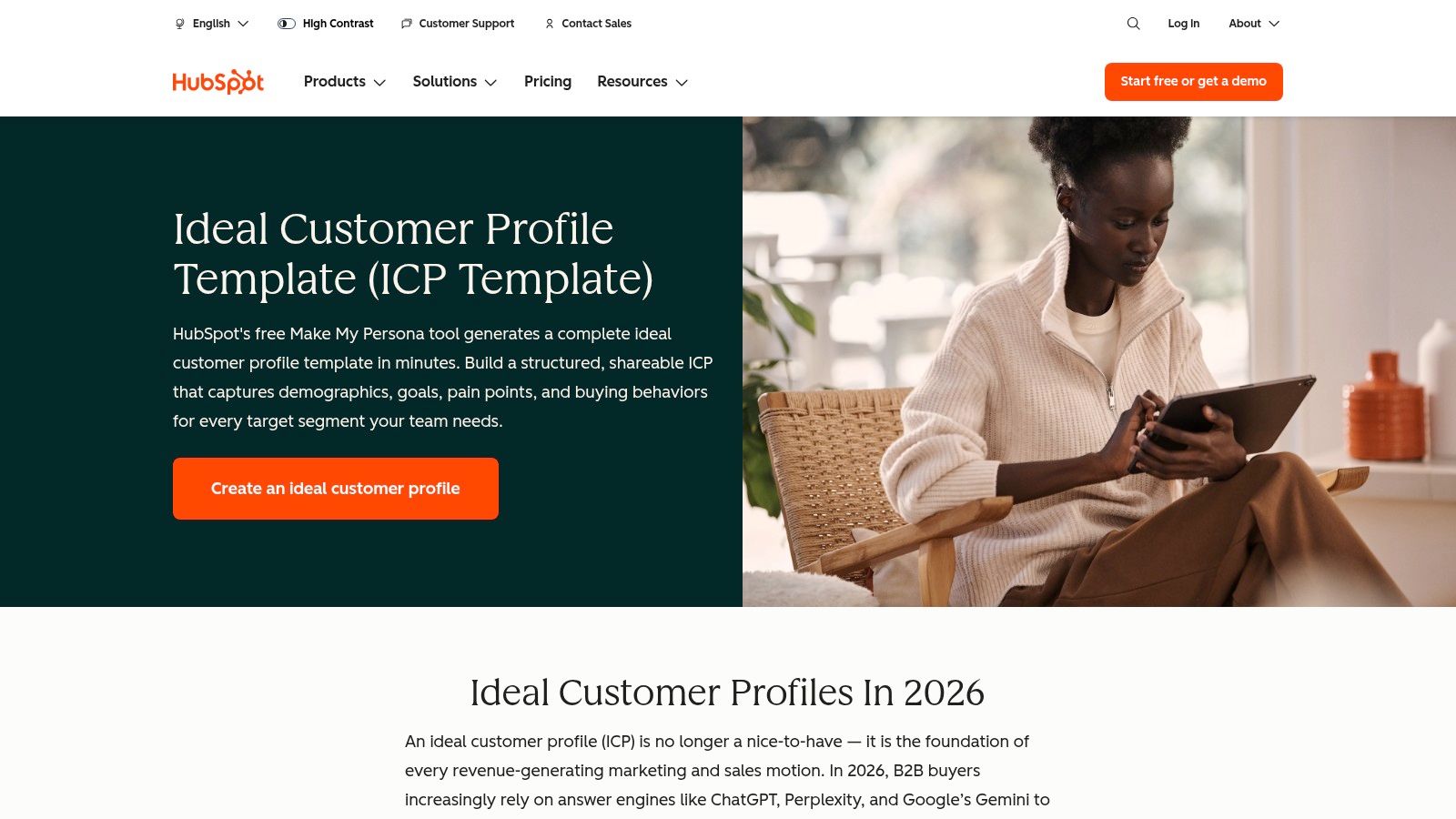
The guided layout looks like this.
Open the HubSpot ideal customer profile template, then revise any detail you can't support with customer evidence.
3. Smartsheet - B2B Ideal Customer Profile and Scorecard Templates
Smartsheet gives you files, not a platform. The B2B profile worksheet documents who the customer is. The scorecard is the part that earns a spot on this list, because you rate a live prospect on need, budget, timeline, and decision process. Downloads come in Word, PDF, Excel, and Google-compatible formats, depending on the template, with guidance and examples beside them.
Most worksheets stop at an attractive company. Fit without timing still wastes a sequence. A company can match industry, size, geography, and stack and still lack urgency, budget authority, or a champion, which is the gap called out by SyncGTM's template notes. I treat the scorecard as the "contact now, nurture, or kill" layer the profile itself doesn't supply.
Profile worksheet: good for a shared definition sales and marketing can both read.
Scorecard: turns that definition into a qualification call instead of a poster.
Friction: the B2B sheet often needs extra columns for tech stack and buying signals, the page is crowded with templates, and some downloads want an account.
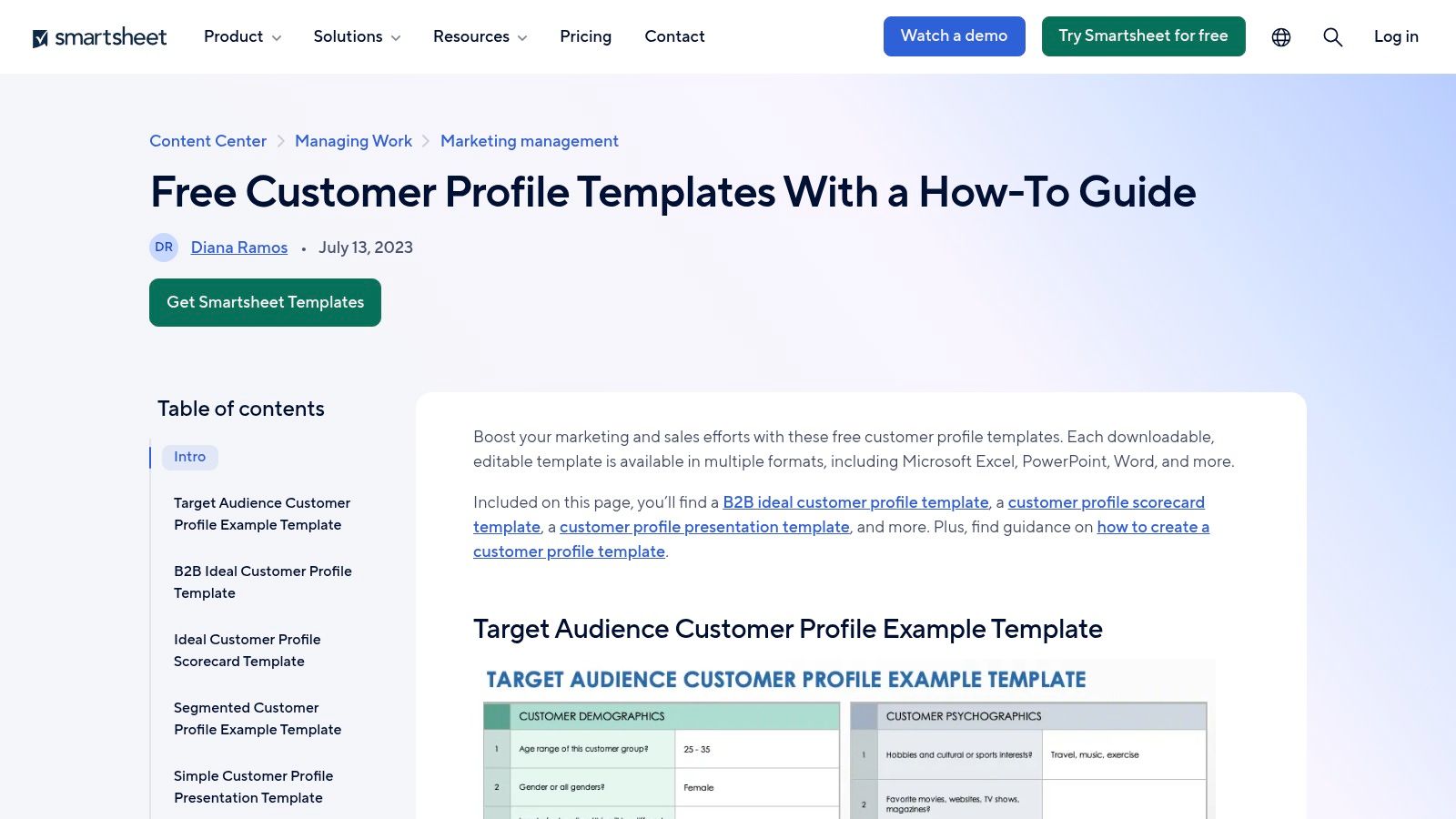
The template library is easy to skim.
If your offer changes by vertical, keep a separate scorecard per market the way industry-specific targeting splits accounts before copy is written. The files live on Smartsheet's customer profile templates.
4. Miro - Ideal Customer Profile Templates
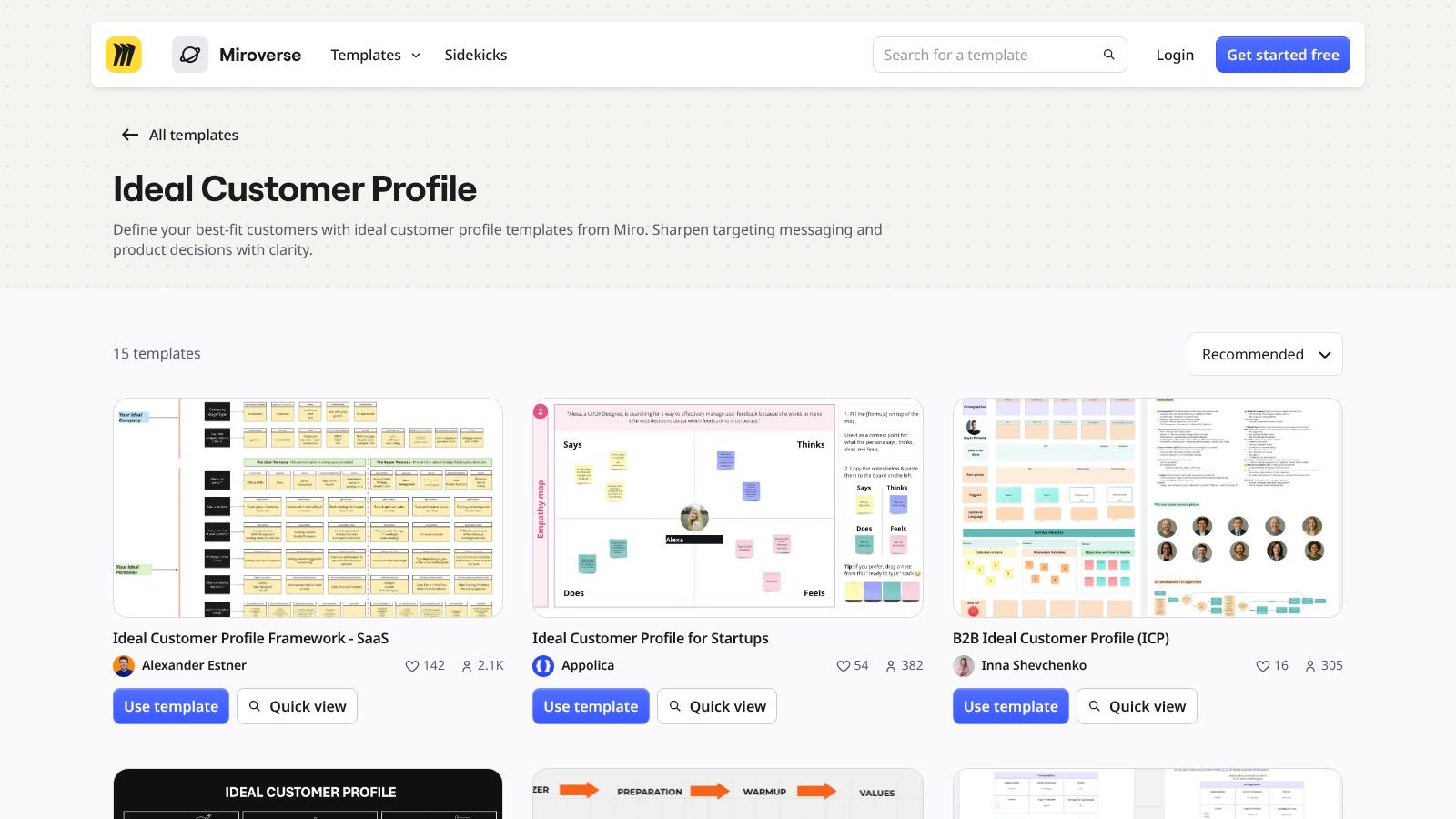
Miro is a wall of boards for SaaS, startups, and B2B, and it's the right room when five people still disagree on who you sell to. Shared editing lets sales, marketing, and delivery drop account traits, buyer needs, and positioning on one canvas during a workshop. You can bend the categories to your own language instead of inheriting someone else's columns.
A board is not evidence. Community templates vary in completeness, and plan limits decide who can edit. Use the session to name the buying group, then leave. LinkedIn's 2024 research with Bain & Company and NewtonX found that B2B purchases typically involve 6 to 10 stakeholders, that 81% of senior buyers said the product ultimately purchased was known by everyone in the buying group on day one, and that only 4% said a purchase happened when only a few decision-makers knew the product. One sticky note labeled "the decision-maker" will not survive that.
The Miroverse set looks like a workshop, because it is one.
After the workshop, copy the agreed fields into a spreadsheet your reps can filter. Browse Miro's ideal customer profile templates for the kickoff, not for the list build.
5. Cognism - ICP Guide and Template
Cognism's guide is research-first. The sample template matters less than the interview questions on buying decisions, pain points, and outcomes. You look for traits that repeat among customers who stayed, then you document the profile and aim it at B2B account targeting. That's the right order for an outbound team that has been guessing verticals.
Account fit and the person who owns the problem are separate scores. LinkedIn's survey of more than 1,700 B2B buyers and technology decision-makers in the United States, United Kingdom, and India looked at how influencers affect purchasing committees, which is a reminder not to treat every employee at a target company as an equal prospect.
Interview prompts beat empty firmographic boxes when you have fewer than a few dozen referenceable customers.
Trade-off: the template sits inside a longer guide, so you'll spend time extracting it. Some of the surrounding content also sells Cognism's data products, and download rules can change.
The article header is the front door, not the worksheet.
Dirty contact data will undo a sharp profile, so clean the list with a lead list cleaner before you trust reply rates. Read the Cognism ideal customer profile guide for the questions, then rebuild the sheet in your own columns.
6. Apollo - ICP Guide and Quick Template
Apollo's quick guide is useful when the next step is building a search, not running a workshop. Its example covers industry, company size, technology, pain points, buyer roles, and buying triggers. Apollo's help material also separates company-level profiles from individual personas, so account fit and contact fit can become distinct filters.
Filters only work when the underlying profile is specific. “Growing companies” is too broad to guide prospecting. Name the signal you can search for, then connect it to a problem, buyer role, or buying trigger.
Strength: free, quick to adapt, and structured around prospecting filters.
Shortfall: it is an example, not a workbook. Search features, credits, and permissions depend on an Apollo account and plan.
The collaboration image is promotional; the practical value is the field list beneath it.
For a comparison of Apollo's database workflow with a done-for-you approach, see the Apollo and Ever Outbound comparison. The framework is on Apollo's ideal customer profile page.
7. Qualtrics - Ideal Customer Profile Template
Qualtrics is the narrow tool I still keep. The download asks for target industries, location and operating geography, and legal or contractual limits. Sales appeal is not the same as market eligibility. If you can't implement in a country, or a contract blocks a vertical, that account is not ideal no matter how loud the pain is.
Privacy rules belong in those geography fields. The UK Information Commissioner's Office states that UK GDPR applies to B2B marketing when personal data is processed, and that a business context doesn't remove it. Consent and legitimate interests are the two bases it highlights, and people can object to direct marketing at any time. Your sheet should record country, contact type, data source, lawful basis, suppression status, and the opt-out path.
Use it when: regulated buyers or a limited service area decide who you may contact.
Skip it when: you need technographics, triggers, and a full buying group. The public description is thinner than the bigger kits, and the file sits behind a form.
Request it from the Qualtrics ideal customer profile resource and paste the constraint fields into whatever workbook you already run.
8. Notion - Appolica Ideal Customer Profile Template
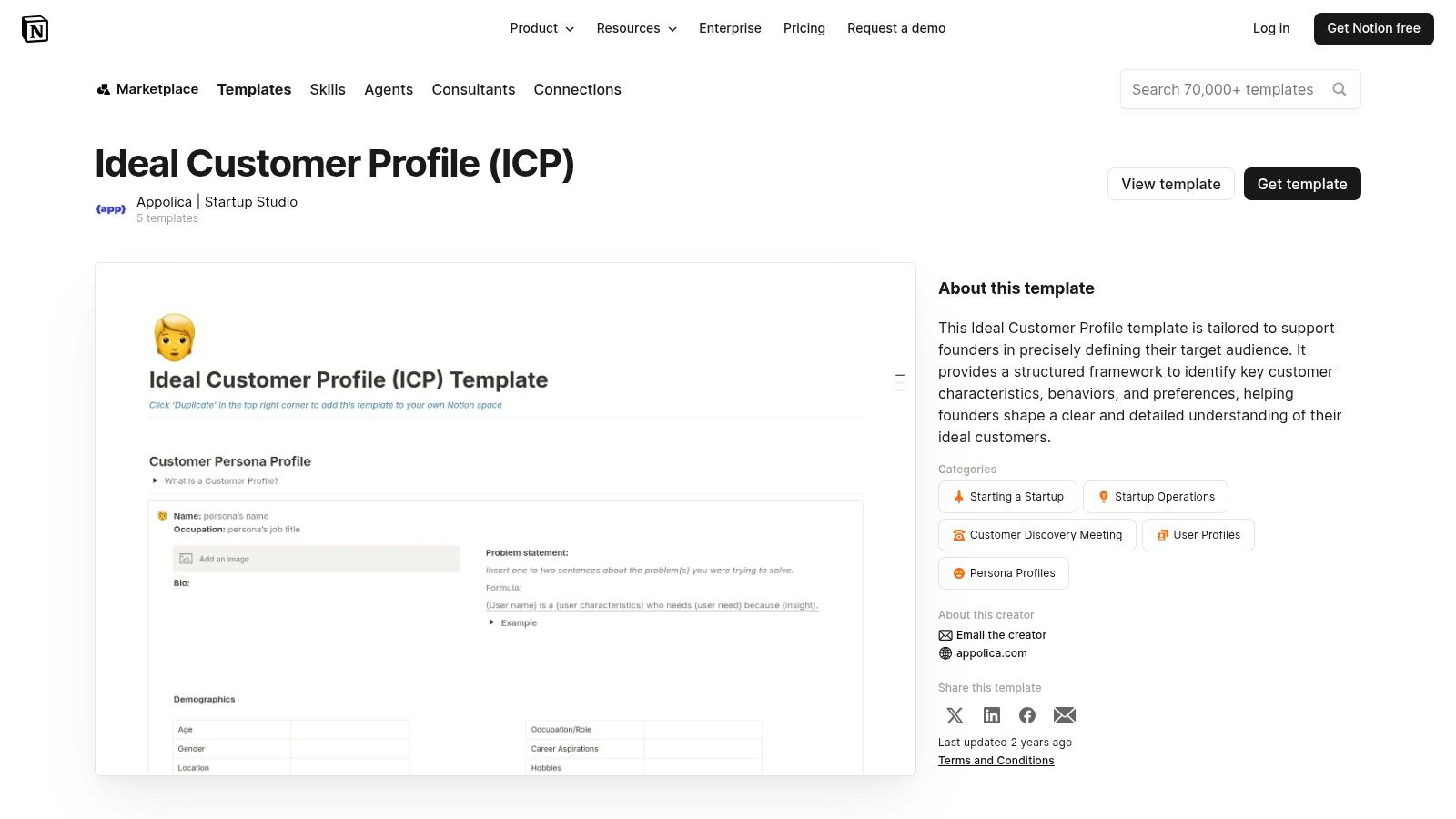
Appolica's free Notion template is a founder notebook, not a sales system. Startup studio prompts cover customer characteristics and behaviors. You duplicate the page, and the profile sits next to research notes, offer drafts, and planning docs you already keep in Notion. The marketplace listing shows ratings and written feedback, though the rating sample is small, so don't treat stars as a methods review.
Who it's for: a small team that lives in Notion and will reopen the page.
Who should pass: anyone who doesn't use Notion. A spreadsheet or a printable file will travel further, and this is a creator template, not a Notion product built for revenue ops.
If the page never becomes a filter, a score, or a disqualifier, it's a journal entry.
The layout is clean enough to live beside your other docs.
Duplicate the Appolica ideal customer profile template on Notion, then export the finished criteria before a campaign depends on them.
9. Canva - Customer Profile Templates
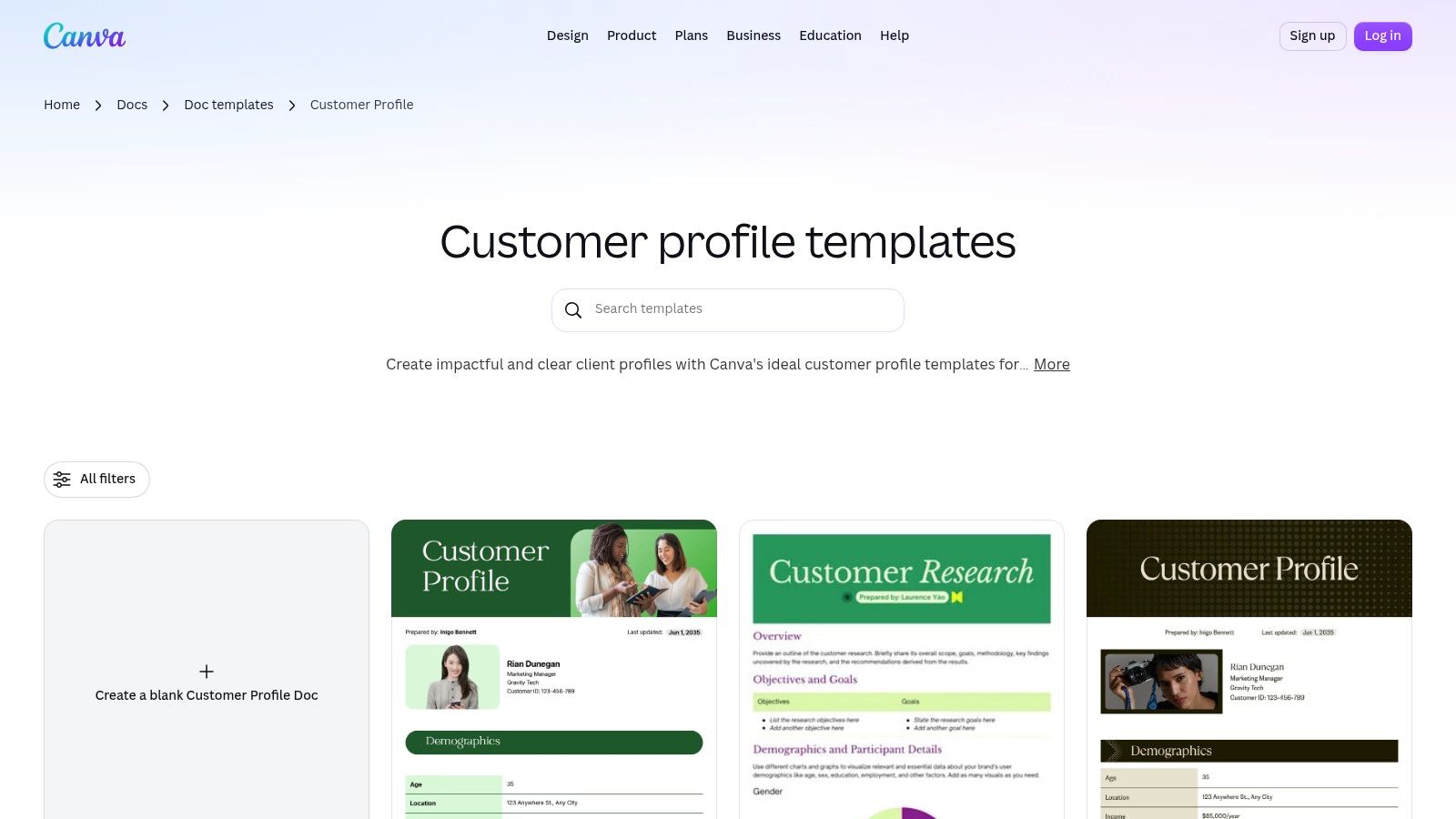
Canva wins the slide and loses the campaign. You get editable customer-profile designs, including B2B options, with drag-and-drop layouts and team comments. Free options exist. Some elements sit on a paid plan. I use it when stakeholders won't read a spreadsheet and need a one-pager for onboarding or a quarterly review.
It will not validate fit. There is no interview guide, no scorecard, and no place that forces a disqualifier. Pretty type does not make a bad vertical a good one. Buyers are also doing their own homework before they ever see your deck. HubSpot's survey of 422 U.S. B2B purchasing decision-makers found that in 2024, 75% preferred to gather product information independently, and 57% purchased a software tool without meeting the vendor's sales team. A polished profile helps your own team. It doesn't replace the research those buyers already did.
The gallery is built for presentation.
Design the leave-behind in Canva's customer profile templates after the criteria are already proven somewhere less glamorous.
10. Salesforce - Ideal Customer Profile Guidance and Persona Templates
Salesforce doesn't hand you one workbook. The guidance explains company-level profiles, tells you to separate them from buyer personas, and pushes you to use customer data and revisit the profile when the market moves. Related persona templates cover motivations, goals, challenges, and behaviors. That split is the useful part. Account selection and the message for one role are not the same document, and teams mix them up constantly.
Buying groups make the split operational. A 2025 Demandbase B2B-buyer report found that 72% of B2B purchases involve complex, multi-stakeholder buying groups. Your account row needs linked people, an economic buyer, a champion, a technical evaluator, procurement, and the person who can block the deal, each with a priority and an objection. Persona slides alone won't do that.
Keep: the distinction between who the company is and who you write to.
Don't expect: a standalone downloadable ICP workbook. Persona files get mistaken for the company profile, and Salesforce software is a separate purchase.
The marketing illustration is the wrapper. The definitions are the asset.
If you'd rather not run the whole engine yourself, how outbound gets run shows the path from a finished profile to booked calls. Read the Salesforce ideal customer profile guidance for the account-versus-persona line, then build the sheet elsewhere.
10 Ideal Customer Profile Templates at a Glance
| Format | Best For | Cost | Main Limitation |
|---|---|---|---|
| Close ICP kit with Google Sheets or Excel templates | B2B teams using customer research to guide targeting and qualification | Free; download may require contact information | Most useful when customer or CRM data is available |
| HubSpot guided ICP tool with examples | First-time users pairing company profiles with buyer information | Free; access may require an account or form | Some prompts focus on individual personas rather than account criteria |
| Smartsheet profile worksheet and scorecard templates | B2B teams documenting customer traits and scoring prospects | Free downloads; some may require an account | Template options can make it hard to know where to start |
| Miro visual ICP boards | Teams collaborating on ICP development in workshops | Cost depends on Miro plan | Visual templates do not provide data validation |
| Cognism guide with interview questions and sample template | B2B teams researching successful customers for account targeting | Free; download or registration requirements may vary | Template can take time to extract and adapt from the guide |
| Apollo guide with quick ICP framework | B2B teams translating ICP traits into prospecting filters | Free guide; platform features depend on plan and account | Example is not a full downloadable workbook |
| Qualtrics downloadable ICP resource | Organizations with geographic, legal, or contractual market constraints | Free to request; form required | Narrower scope than more comprehensive kits |
| Appolica Notion template | Founders and teams already using Notion for research and planning | Free | Creator-made template; less suitable for non-Notion users |
| Canva customer-profile designs | Teams creating a polished ICP document for sharing | Free options; some features require a paid plan | Better for presentation than rigorous research or validation |
| Salesforce ICP guidance and persona templates | Teams aligning company-level account fit with buyer-role understanding | Free guidance and template resources | No standalone downloadable ICP workbook |
Fill It Out, Then Point It at Real Prospects
Pick one template from this list and finish it against customers you have already won and lost. Opinions from a pipeline meeting don't count. Write the industry, size, geography, stack, contract value, and the pains that showed up more than once. Add the roles who sign, the triggers that made them look, and the conditions that make you walk away. Then stop editing the document and point it at work. Saved searches, a qualification scorecard, and the first lines of outreach should all use the same fields. If a criterion never changes who gets emailed, delete it.
Some teams would rather not build the lists, the domains, and the sequences themselves. We're pay-per-close. You hand us the finished ideal client profile, and we build hand-verified lists of decision-makers from it, write personalized outreach from scratch with real context on each prospect, and book qualified calls straight onto your calendar. You pay a 5% commission only when you close a deal from that work, and your first 2 closes are commission-free, so we don't get paid for activity that never becomes revenue. Every client gets a private dashboard that shows campaigns, replies, interested prospects, and booked calls in real time. That's where the template pays off, in meetings you can see, not in a slide nobody opens.
Bring the finished profile to a conversation and we'll walk through how a campaign gets built and what shows up on the calendar. If you still want to run prospecting in-house, the same discipline applies. Pipeline building for revenue leaders only works when the accounts you chase already match the customers who stayed. A template that never leaves the folder didn't fail because of the software. It failed because nobody aimed it at a real prospect.
Ever Outbound Inc. takes a finished ideal customer profile and turns it into hand-verified decision-maker lists, human-written outreach, and qualified calls on your calendar, and we're pay-per-close so the work is tied to deals you win. If your template is done and you'd rather not build the engine around it, bring it to Ever Outbound Inc. and we'll show you how the campaigns, replies, and bookings show up from there.