October 22, 2026
Cybersecurity Lead Generation That Builds Pipeline
You finally got budget approved, built a list, and launched cybersecurity lead generation outreach to security directors who should care. A week later you've got a handful of polite no's, a few unsubscribes, and silence from everyone else. It's not that these buyers don't need help. It's that your message sounded exactly like the other vendors in their inbox, so it got treated like them too.
Table of Contents
- Why Generic Cybersecurity Outreach Misses
- Build a Precise Cybersecurity ICP
- Match Buyer Pain to Proof
- Create Outreach That Earns Trust
- Choose Channels for Buying-Committee Reach
- Protect Compliance and Sender Reputation
- Qualify Leads and Prove Pipeline Impact
Why Generic Cybersecurity Outreach Misses
A rep opens Monday with a confident subject line, something about cybersecurity solutions, and sends it to a security director who's already juggling an audit, a staffing gap, and a board update. The email promises end to end protection, peace of mind, and a quick demo. It doesn't mention what problem she has this month. She deletes it between sips of coffee, not out of malice, just triage.

That deletion is predictable when you look at what buyers are responding to. Verizon's 2025 Data Breach Investigations Report analyzed 22,052 real world security incidents, including 12,195 confirmed data breaches across 139 countries. In that dataset, credential abuse accounted for 22% of breaches and exploitation of vulnerabilities accounted for 20%, while vulnerability exploitation rose 34% year over year and ransomware appeared in 44% of confirmed breaches. Those aren't one generic problem called security. They're different fires, owned by different people, with different budgets attached.
Lead Volume Is Not Lead Generation
A list of 10,000 contacts who received the same vague pitch isn't pipeline. It's activity. Real cybersecurity lead generation starts by naming the security event, operating constraint, or exposure that makes an offer timely for a specific account, then earning a conversation with the people who can act on it.
If your first line could be sent to a hospital, a fintech, and a forklift distributor without changing a word, it isn't personalization. It's a mail merge with ambition.
Compare two openers. The weak one says you help companies stay secure and compliant. The stronger one says you noticed the company added remote access for a new location, and you help similar teams check whether internet facing devices are patched before an insurer asks. One asks the buyer to do the translation work. The other does it for her.
That restraint matters because cybersecurity purchases are committee driven. A technical evaluator, a budget owner, and a risk owner can each kill a deal for different reasons. Credibility has to survive all of them, which means your copy quality is only part of the job. Persona selection, trigger timing, proof, compliant sending, channel choice, and honest qualification decide whether a reply becomes revenue or just another thread your AE has to apologize for.
Build a Precise Cybersecurity ICP
Start narrower than feels comfortable. A useful ideal customer profile for cybersecurity lead generation isn't mid market companies that care about security. It's a set of observable fields you can research, score, and write to.
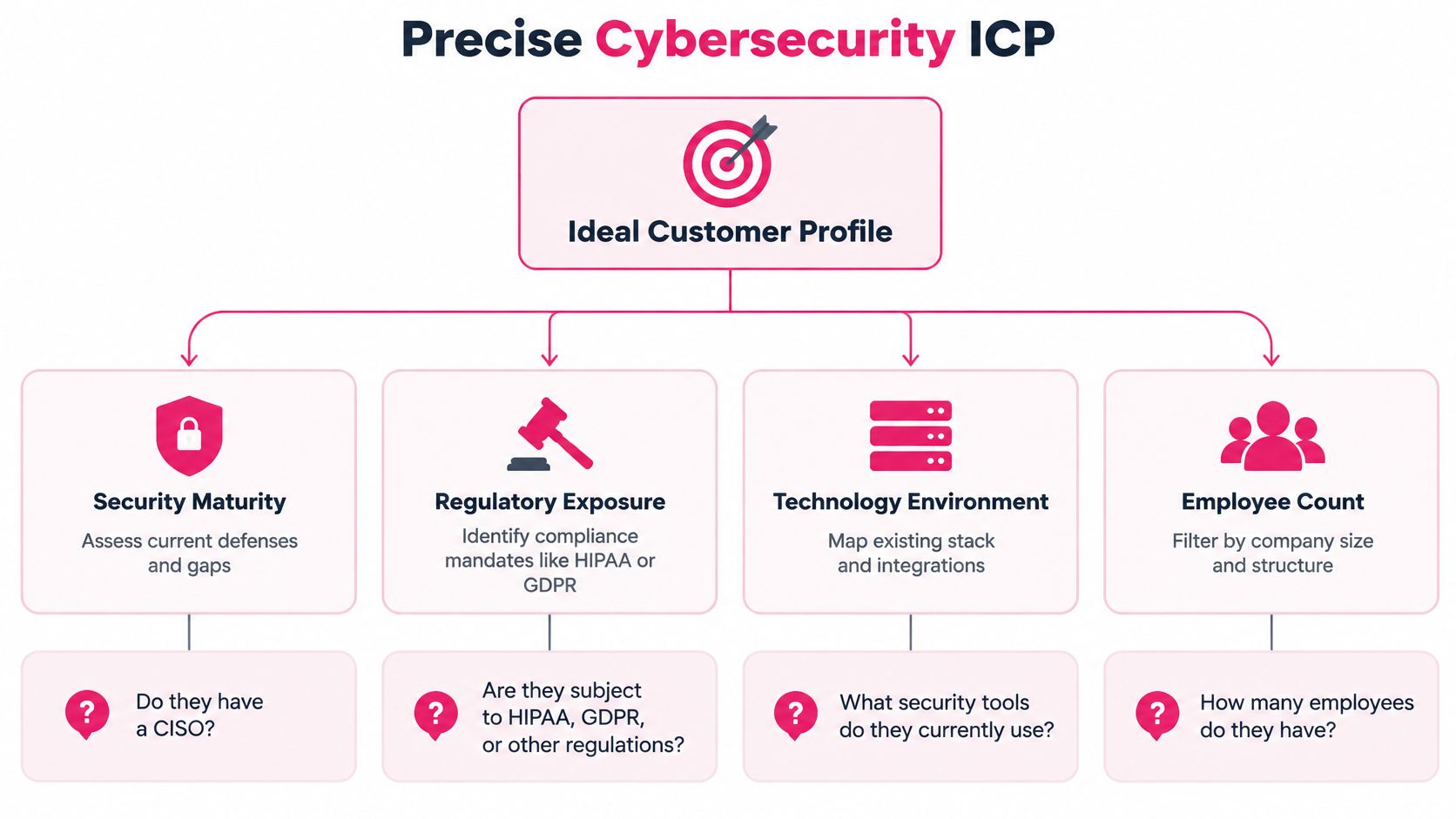
Build the profile around security maturity, regulatory exposure, technology environment, employee count, incident history, third party dependence, and available execution capacity. A company with a CISO, a SOC, and documented controls needs a different conversation than a company where the IT manager is also the security team, help desk, and unofficial incident responder. Both can buy. They just won't buy the same thing for the same reason.
For regulated verticals, specificity compounds. Hospitals, for example, face patient data obligations that make generic IT pitches sound careless, which is why resources on cybersecurity solutions for hospitals are useful context when you're segmenting healthcare accounts by compliance pressure rather than headcount alone. Similar logic applies when you're selling alongside or into managed providers, a motion covered in our work with IT managed services firms, where the buyer may care as much about delivery capacity as technical depth.
Triggers That Create Urgency
Triggers turn a firmographic fit into a timely segment. Prioritize combinations, not single signals.
- Incident or near miss: A recent phishing event or supplier compromise makes detection and response concrete.
- Audit or insurance renewal: Failed findings and renewal questionnaires create deadlines nobody can wish away.
- Cloud migration: New infrastructure usually means new identity, logging, and configuration gaps.
- Board reporting: Executives asking for risk posture in plain English create demand for assessments.
- Staffing gap: An unfilled analyst role often matters more than any product category.
That last trigger deserves its own segment. ISC2's 2025 Cybersecurity Workforce Study reports 33% of organizations lack sufficient resources to staff cybersecurity teams and 29% can't afford people with the skills they need, while 59% report critical or significant skills needs. The same study cites AI skills at 41% and cloud security at 36%. Limited budgets don't eliminate demand here. They shift it toward services that substitute for scarce skills and prove value quickly, without adding headcount.
Human and supplier exposure create separate segments too. Verizon reports the human element remained involved in roughly 60% of breaches, and its small and medium business snapshot says third party involvement doubled from 15% to 30%. So one account may need phishing resilience, while another needs vendor risk oversight. Lumping them together guarantees both messages land flat.
Map the Buying Committee Early
Don't build the ICP around the CISO alone. Map security, IT, operations, finance, compliance, procurement, and executive stakeholders, then note who feels the pain, who validates technically, and who signs. In an understaffed team, your practical buyer may be an IT leader or operations executive who wants predictable coverage. In a mature team, a security architect may care about integration and alert quality.
End with account fields your team can fill: regulator, stack, supplier dependence, security leadership present or absent, open security roles, recent trigger, committee contacts, and execution capacity. A segment like regulated, cloud heavy, no in house SOC, insurance renewal approaching gives a writer something true to say. Mid market company gives her a blank page and a deadline.
Match Buyer Pain to Proof
Once accounts are segmented, the mistake is sending every stakeholder the same value proposition with a different first name. Economic, technical, compliance, and resource constrained buyers don't evaluate proof the same way. Match the message to the decision each person has to defend internally.
Money is the clearest translator, if you use it with integrity. IBM's 2025 Cost of a Data Breach study of 600 organizations found a global average breach cost of $4.44 million, down 9% from $4.88 million in 2024, while the United States reached a record $10.22 million. The same research put malicious insider incidents at $4.92 million and supply chain compromises at $4.91 million, and Gartner projected worldwide end user information security spending at $213 billion in 2025, up from $193 billion in 2024. Use those figures as risk context for why a problem deserves budget. Don't present them as savings your service guarantees. Buyers notice that sleight of hand, and finance will too.
Cybersecurity Buyer Message Matrix
| Buyer priority | Lead with | Useful proof | Sensible next step |
|---|---|---|---|
| Economic | Cost of disruption and recovery | Breach cost benchmark, scoped business case | Short risk and cost review |
| Technical | Specific exposure in their stack | Diagnostic findings, architecture fit, remediation path | Narrow technical assessment |
| Compliance | Audit readiness and evidence gaps | Control mapping, reporting sample | Compliance gap review |
| Operational | Workload the team can't absorb | Coverage model, response workflow | Capacity and coverage discussion |
| Resource constrained | Outcome without new headcount | Managed process, clear boundaries | Pilot with defined scope |
The matrix keeps you honest. A CFO doesn't need a lecture on credential abuse mechanics. She needs to know what exposure costs if it's ignored and what a bounded fix looks like. A security engineer doesn't need a board level fear appeal. He needs to know whether your identity controls work with his environment and what evidence supports that claim.
What This Sounds Like in Copy
For identity protection, tie the opener to credential theft as an initial access problem, then offer a review of privileged accounts and authentication gaps. For supplier risk, ask how the team monitors vendors and cloud providers, not just internal controls, and offer a third party exposure snapshot. For an understaffed team, skip the doom and lead with reduced analyst workload, faster remediation, or predictable outsourced coverage.
Compliance buyers respond to method, not adjectives. If you're discussing vendor evaluation, point to a structured approach such as NIST-aligned due diligence as an example of the rigor procurement expects, then show how your process produces evidence they can reuse. Proof also travels sideways inside an account, so make it easy to forward. That's why documented client proof and outcomes matter more than a clever subject line when a champion has to sell you internally.
Geography changes the math too. A global benchmark fits global campaigns, while US accounts face a different cost picture. Staffing, regulation, and recent events should change the message the same way. The takeaway isn't pick a scarier number. It's give each buyer a reason that survives scrutiny from the person sitting next to them.
Create Outreach That Earns Trust
Trust is the gating item in cybersecurity lead generation, especially when your offer involves sensitive access or managed services. Buyers aren't just evaluating whether you can help. They're evaluating whether talking to you creates risk.
The behavior data explains the caution. Buyer research summarized by Centerline reports 78% of buyers shortlist only vendors they already know and 77% read user reviews before buying, with purchases commonly involving six to ten decision makers. Separate buyer research summarized in industry coverage indicates 79% of buyers initiate first contact themselves, the selection phase consumes roughly 60% of the buying cycle, and 56% speak with a product user before purchasing, rising to 71% among enterprise buyers, as detailed in Stratabeat's summary of cybersecurity buyer behavior. Translation, you rarely win by demanding a call from a stranger. You win by becoming verifiable before the call.
Build a Trust Ladder
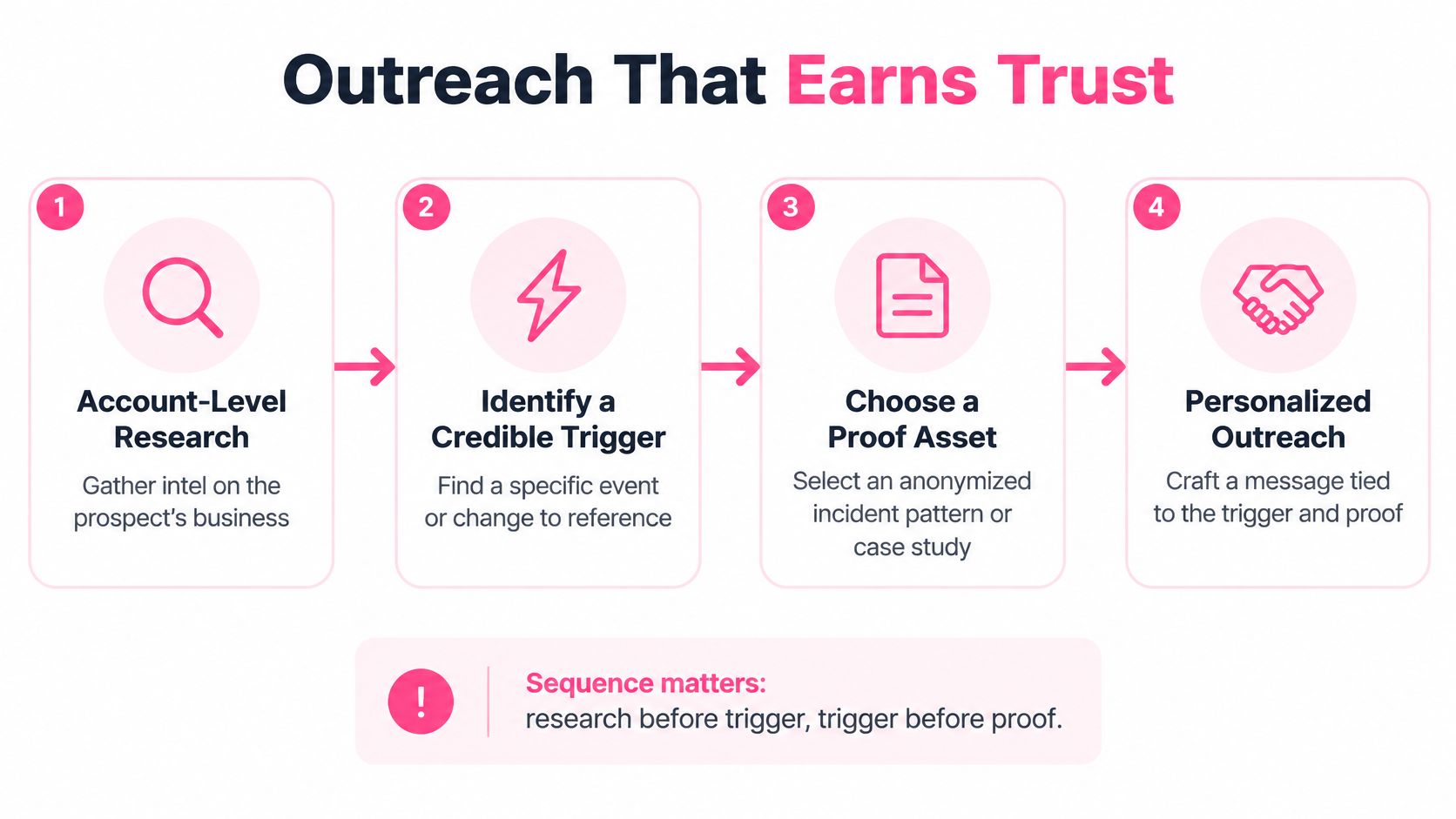
Work in sequence. First, do account level research on the environment, leadership, suppliers, and recent changes. Second, pick one credible trigger, not three stitched together. Third, choose a proof asset that fits that trigger, such as an anonymized incident pattern, a compliance gap observation, a benchmark, a narrowly scoped diagnostic, or a completed security questionnaire. Fourth, explain boundaries: what you'll access, what you won't, how data is handled, and what happens after a meeting.
Practical rule: Offer evidence a buyer can verify without trusting you first. The call is step two, not the entrance fee.
A short email built on that ladder might read: Noticed your team is hiring its first security analyst while expanding cloud workloads. Teams in that spot often have logging in place but nobody watching it after hours. We run a scoped coverage review that maps what is monitored, what is not, and what an insurer is likely to ask. Want me to send the one page outline, no access required?
That works because the call to action offers relevance instead of demanding a generic demo. The buyer can say yes to information before saying yes to a vendor. Follow up with a different proof point, not the same message wearing a new subject line. Add a reference from a comparable organization, a relevant diagnostic question, or a subcontractor and data handling note.
The short walkthrough below shows how research and restraint change the tone of a first touch.
Human research beats generic AI scale here. Identical copy sent widely signals that you didn't look, and security buyers are professionally trained to distrust people who didn't look. Slow down the first touch, and the second one gets easier.
Choose Channels for Buying-Committee Reach
Adding channels doesn't rescue weak targeting. It just distributes a weak message more efficiently. Choose channels by the job each one does for a specific committee member, then keep the story consistent across all of them.
Personalized email should carry your primary hypothesis because it's where you can state the trigger, the consequence, and the proof in one place. Send the technical version to the technical validator and the business consequence version to the economic buyer. Don't forward the same thread to six people and call it multi threading. That's just group spam with better intentions.
Assign Each Channel a Job
Professional network engagement warms committee members who won't reply cold. Comment on a prospect's post about audit season, share a relevant benchmark, or connect after a shared event. When you use this layer deliberately, a structured LinkedIn outreach system helps keep touches coordinated instead of turning into random connection requests from three reps in one week.
- Email: States the trigger, proof, and low friction next step.
- Professional network: Builds familiarity with validators and champions before you ask for time.
- Retargeting: Reinforces one proof asset for people who already visited a relevant page.
- Human follow up: Converts context rich replies into qualified conversations while context is fresh.
Retargeting works best when the asset matches the account's trigger. If a prospect read about testing, don't serve a generic brand ad. Serve something that deepens that exact evaluation, such as MSSP pentest reporting best practices, which speaks to how findings get communicated to clients and auditors. That specificity tells an MSSP buyer you understand the deliverable, not just the test.
Sequence by account maturity. Cold accounts need a narrow trigger and credible evidence first. Known accounts can handle expansion or risk based follow up tied to an existing relationship. Warmth isn't a license to get vague, though. A prior download from two quarters ago doesn't make a generic check in feel personal.
Control frequency and attribution like an adult. Cap touches per person, suppress people who've opted out everywhere, log which role received which angle, and attribute meetings to the combination that produced them. Otherwise you'll credit the last email for work done by a helpful comment, a useful asset, and a rep who replied quickly.
The best channel mix feels boring from the outside. Same truth, told appropriately to each stakeholder, at a pace that doesn't make your brand feel like a pop up ad.
Protect Compliance and Sender Reputation
Cybersecurity buyers judge your operational hygiene before they judge your service. If your outreach looks deceptive, untracked, or impossible to stop, you've answered their vendor risk question early, and not in your favor.
Start with the legal floor for US commercial email. The FTC's CAN-SPAM compliance guide states there's no business to business exception, each separate violating email can incur penalties of up to $53,088, senders must honor opt out requests within 10 business days, and the opt out mechanism must keep processing requests for at least 30 days after sending. Required mechanics include accurate From, To, Reply To, and routing information, a non deceptive subject line, clear identification that the message is an advertisement, and a valid physical postal address. Suppression lists and monitored replies aren't deliverability garnishes. They're operating requirements.
Build Deliverability Like Infrastructure
Run a tight workflow before volume enters the conversation:
- Verify contacts first: Suppress role accounts, invalid addresses, duplicates, and prior unsubscribes.
- Authenticate sending domains: Set up SPF, DKIM, and DMARC before launch, and keep campaign infrastructure separate from your primary corporate domain.
- Ramp gradually: Increase volume across multiple mailboxes, cap daily sending, and watch bounce, complaint, reply, and placement signals.
- Pause weak segments: Don't compensate for deteriorating performance by sending more.
- Connect outcomes to CRM: Tie every reply and meeting to an opportunity so reputation decisions use revenue data, not vibes.
A quick preflight with an email deliverability checker belongs in that workflow, before a new segment goes live and after any infrastructure change. It's cheaper than rebuilding a burned domain and much less awkward than explaining to a CISO why your security pitch landed in spam.
Treat common failure modes as disqualifiers. Buying unverified lists, rotating domains to evade reputation problems, sending identical AI generated copy at scale, and making unsupported breach claims about a prospect will all backfire in this market. Security leaders fact check vendors for a living. If you claim you found their exposed server, you'd better be right and able to prove how you know.
Start experiments small. Use validated cohorts, plain text personalization tied to a real trigger, a low friction call to action, and automatic suppression after a clear opt out. Opens are too unreliable to steer by because privacy features inflate and obscure them. Delivery alone can also hide spam folder loss, so placement deserves its own check. Protect the sender, and you protect every future campaign that sender will run.
Qualify Leads and Prove Pipeline Impact
A curious reply isn't an opportunity, and a booked meeting isn't pipeline. Qualification is where cybersecurity lead generation either becomes a revenue system or a calendar decorating exercise.
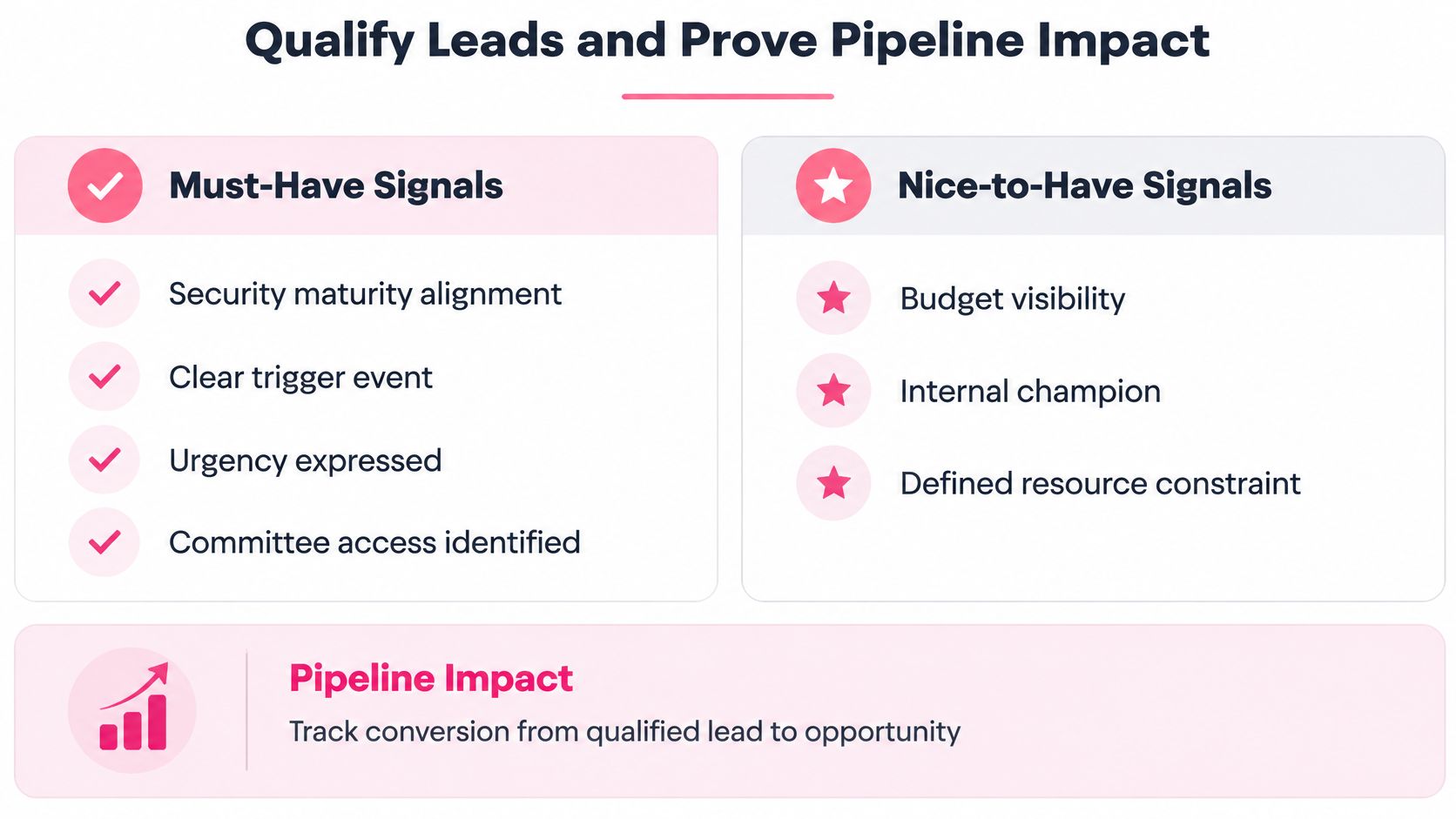
Separate signals before your reps start grading on enthusiasm.
Must Have Versus Nice to Have
- Must have security maturity fit: Their current controls and gaps match what you deliver.
- Must have clear trigger: An incident, audit, renewal, migration, or staffing gap gives the conversation a reason now.
- Must have urgency: A deadline or named consequence exists, even if budget isn't final.
- Must have committee access: You can reach a validator and an economic owner, not just one friendly contact.
- Nice to have budget visibility: Helpful, but early honesty about constraints beats a made up number.
- Nice to have internal champion: Someone willing to forward proof and convene stakeholders.
- Nice to have defined resource constraint: A named gap your service can absorb measurably.
You don't need a full sales cycle on the first reply. Ask what triggered interest, who else owns the problem, what happens if it waits a quarter, and what evidence they'd need to proceed. A structured step like a short qualification review keeps those answers consistent across reps instead of living in scattered inboxes. A technical contact exploring options for next year may be worth nurturing. Don't let polite curiosity consume AE time meant for accounts with a live deadline.
Measure what proves impact. Track positive response rate, qualified meeting rate, sales accepted opportunities, pipeline generated per 1,000 contacts, and complaint or unsubscribe rates. Opens belong in the basement. For directional context only, GetResponse benchmarks report approximately 39.64% average opens, 3.25% click through, 2.33% bounces, and spam complaints below 0.01% across 4.4 billion messages, while a Validity summary reports 84.3% inbox placement despite 98.16% delivery. Those benchmarks warn you that delivered doesn't mean seen. They aren't targets your narrow, trigger based cohorts should chase blindly.
Judge a segment by opportunities created and complaints avoided. A loud campaign that burns trust is expensive even when the spreadsheet looks busy.
Troubleshoot by symptom. Low replies usually mean weak trigger or mismatched proof, so rewrite by segment before raising volume. Weak meeting quality means qualification questions are too loose. Poor placement means pause, inspect authentication and list quality, and cut the segment that's dragging reputation down. False positive leads mean your call to action promised generic content instead of a specific diagnostic.
Launch checklist, kept short: precise ICP, mapped committee, one trigger per segment, role matched proof, compliant infrastructure, suppression in place, CRM outcomes defined. Run that, and cybersecurity lead generation stops being a volume gamble. It becomes a qualification system that earns trust early and proves itself in pipeline.
If you want this kind of trigger based, committee aware outreach built and run for you, we're pay-per-close at Ever Outbound, so you only pay a 5% commission when you close a deal from our work and your first two closes are commission free. Our human research, copywriting, and appointment setting team handles the lists, personalization, deliverability, and booking, and you show up to qualified calls ready to close. Start with Ever Outbound Inc. and put that pay-per-close model to work on your next cybersecurity campaign.