October 29, 2026
Cold Email Follow Up Template: 7 Ready-to-Use Examples
You sent a sharp first email. The prospect didn't reply. Now you're staring at a draft that says “just checking in,” which is technically a follow-up and practically a request for someone else to rescue the conversation.
The problem isn't that you followed up. It's that the recipient has no fresh reason to answer. They might have missed your message, questioned your relevance, or forwarded it to someone who promptly went on holiday. Those situations need different responses, not the same reminder with increasingly nervous punctuation.
A useful cold email follow up template starts with the situation, then gives the prospect an easy next step. That holds whether you're contacting enterprise buyers or doing email outreach for Instagram sourced leads. The source of the lead doesn't replace the need for relevance.
Pick the lightest message that fits what you know. Replace every placeholder with something defensible, leave out the theatrical urgency, and don't mistake an automated sequence for permission to keep sending forever.
Table of Contents
- 1. The Simple Bump
- 2. The Value-Add Follow-Up
- 3. The Breakup Email
- 4. The Single-Question Follow-Up
- 5. The Social Proof Follow-Up
- 6. The Referral or Redirect Follow-Up
- 7. The Different-Angle Follow-Up
- How the 7 Cold Email Follow Up Templates Compare
- Match the Template to the Silence
1. The Simple Bump
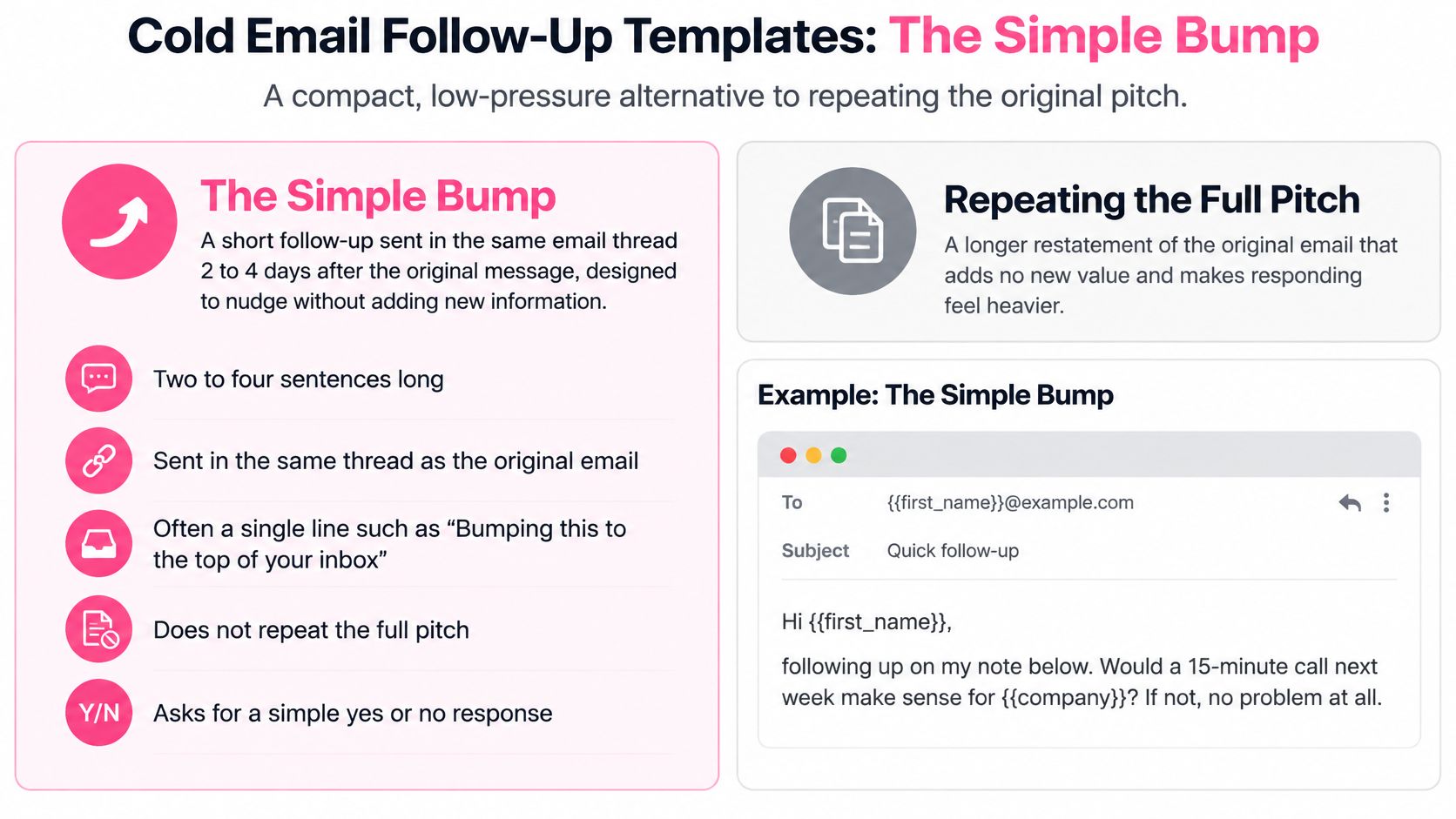
The silence this fits: No answer yet, no objection, and a first email that already explains the problem and your offer clearly. Assume the message was missed, not that the prospect needs another sales pitch.
For an agency approaching a marketing director about stalled case-study production, a short reply in the original thread keeps the context available without making them reread a new introduction.
Send this as an in-thread reply:
Hi {{first_name}},
Bumping my note below in case it got buried. Is getting {{specific_outcome}} moving something you'd consider for {{company}}?
If it's not a priority, no problem.
{{sender_name}}
Keep the Nudge Small
I'd wait two to four business days before using this template. That's a starting cadence, not a universal optimum: Emailchaser's cold-email benchmarks report that 91% of replies arrive within three days, so an immediate reminder can overlap with a response that hasn't arrived yet.
Keep the message under fifty words, preserve the original subject, and avoid manually adding a fake reply prefix to a new conversation. Change the wording to fit your voice rather than sending identical bumps repeatedly.
This visual summarizes the approach.
Its limitation is obvious: It adds almost nothing. If the original pitch was vague, you're resurfacing a vague pitch.
For a sequence starting point, use the email sequence generator. At Ever Outbound, we're pay-per-close. Edit the outline around the prospect's situation rather than treating every blank space as another bump.
2. The Value-Add Follow-Up
The silence this fits: The prospect hasn't replied, and asking for a meeting may be premature. You have something useful to share, such as an onboarding checklist, a relevant teardown, or a practical observation.
Think useful working document, not a brochure wearing a helpful hat.

Try this when a public hiring signal creates a relevant opening:
Hi {{first_name}},
Saw {{company}} is hiring {{role}}. That can make {{specific_process}} harder to keep consistent.
I put together a short checklist for reviewing {{relevant_problem}}: {{resource_link}}
The section on {{specific_detail}} may be useful while you're hiring. Happy to explain the thinking if helpful.
{{sender_name}}
Give Before You Request
A consultant contacting a SaaS founder might share a customer-handoff checklist after spotting implementation vacancies. The resource should help that founder evaluate a problem even if they never book a call.
Use a plain-text link to a page you control, not a heavy attachment. Explain which part matters so the recipient doesn't have to excavate the relevance themselves.
- Make the connection explicit: Tie the resource to the company's actual trigger.
- Keep the ask optional: Don't disguise a compulsory discovery call as a free resource.
- Review the language: When you turn AI drafts into authentic emails, replace generic praise with a concrete observation.
For another perspective on follow-up writing, watch this video.
The limitation: Generic content isn't added value. Track which resources produce relevant conversations, not just clicks.
3. The Breakup Email
The silence this fits: You've made a reasonable attempt, introduced useful context, and still have no response. You're ready to stop, not pretending to stop as a negotiation tactic.
This can suit a busy prospect who expressed interest earlier, but an agreed follow-up date takes priority over your automated schedule.
Subject: Closing the loop
Hi {{first_name}},
I haven't heard back, so I'll close this out and stop reaching out.
If {{outcome}} is still relevant, reply interested and I'll send the next step. Otherwise, no action needed.
Best of luck with {{company_goal}}.
{{sender_name}}
Close the Loop Without the Drama
Skip the guilt, mock disappointment, and suggestion that the prospect owes you an explanation. You're ending an outreach attempt, not dissolving a business partnership.
Practical rule: If you say you'll stop, stop. A final email followed by another final email makes every promise less believable.
Keep the lead record with its status and history. Don't automatically move an unresponsive prospect into a newsletter; future nurture needs an appropriate permission and compliance basis.
Woodpecker's follow-up guidance notes that US commercial email must offer an opt-out mechanism and that CAN-SPAM requires honoring opt-out requests within 10 business days. Operationally, suppress objections immediately rather than treating the legal window as a sending allowance.
Use the lead list cleaner during list maintenance, while keeping opt-out suppression intact. Cleaner copy helps too: the restraint useful in email polishing tools for job seekers applies here, although the audience differs.
Limitation: Closure isn't a magic reply trigger. Its main job is to leave the relationship intact.
4. The Single-Question Follow-Up
The silence this fits: You don't know whether the problem matters, and another meeting request would skip an important qualification step. Ask something the prospect can answer without consulting a spreadsheet.
A cybersecurity consultant, for example, might need to learn whether access-review improvements are active or deferred. That's more useful than asking whether the recipient wants better security. Everyone wants better security.
Send this:
Hi {{first_name}},
With {{specific_trigger}} underway, is {{specific_problem}} something your team is actively addressing, or is it parked for now?
{{sender_name}}
The aim is a clear answer, not a miniature discovery questionnaire.

Diagnose Before You Schedule
If ownership is unclear, replace the priority question with: Who owns {{process}} at {{company}}? Don't stack ownership, budget, timing, and meeting availability into the same message.
- Active priority: Ask what's holding progress back, then suggest a relevant next step.
- Deferred priority: Request permission to reconnect around the prospect's stated timing.
- Wrong recipient: Offer to contact the appropriate owner directly.
Use the cold email grader to inspect the draft, then read it yourself for assumptions a tool might miss. A technically tidy question can still be presumptuous.
The limitation: An answer isn't buying intent. Someone confirming they own onboarding hasn't agreed that onboarding is broken or that you should fix it.
Treat the reply as information. Personalize the next message from what they said, not what you hoped they meant.
5. The Social Proof Follow-Up
The silence this fits: The prospect may understand your offer but lack a reason to believe you can deliver. Use relevant evidence instead of adding more adjectives to the promise.
A recruiting firm approaching an operations leader should choose proof about comparable hiring constraints, not its most glamorous client logo.
Use this only after validating every placeholder:
Hi {{first_name}},
We helped {{approved_client_name}}, a {{comparable_company_type}}, move from {{verified_before}} to {{verified_after}} over {{verified_timeframe}}.
Their main constraint was {{relevant_constraint}}. Given {{company}}’s focus on {{goal}}, would the short breakdown be useful?
{{sender_name}}
Good proof helps the prospect understand the work, not just admire the result.

Match the Constraint, Not Just the Industry
Use a substantiated result with client permission. Preserve its original measure: prospects aren't customers, booked meetings aren't attended meetings, and pipeline isn't collected revenue.
At Ever Outbound, we're pay-per-close, and we can supply named case studies for relevant outreach. Clarkson Group, an ecommerce and Amazon consultancy with fractional COO services, was connected with 52 ready-to-buy prospects through our efforts. That's a prospect outcome, not a claim about closed deals.
You can review the named client examples for context.
A comparable constraint often matters more than a famous logo. Show why the example belongs in this buyer's inbox.
The limitation: A strong case study doesn't prove the same outcome is available to everyone. Keep the email focused on a relevant result and offer the explanation, rather than presenting a guarantee you can't support.
6. The Referral or Redirect Follow-Up
The silence this fits: You may have reached the wrong person. Perhaps a founder delegated operations, or a marketing leader doesn't own sales development.
This is an ownership problem, not necessarily a persuasion problem. Don't send a stronger pitch to compensate for a weaker contact match.
Try this:
Hi {{first_name}},
I may have reached the wrong person. Does {{specific_role}} own {{process}} at {{company}}, or does that sit elsewhere?
If it's outside your remit, a name or role would help me send the right person a short note.
Thanks,
{{sender_name}}
Make the Redirect Easy
Specify the function you need. An MSP asking about endpoint management should identify IT ownership rather than vaguely requesting whoever handles technology.
Cirrus Insight's outreach statistics summary reports that reaching multiple relevant contacts within an organization increased response rates by approximately 93% in the analysis it summarizes. That supports thoughtful account coverage, not emailing an entire leadership page simultaneously.
- Record the referral: Save the contact, role, source, and any restrictions in your CRM.
- Ask before attributing: Get permission before using the referrer's name as an introduction.
- Write fresh context: Explain relevance to the new recipient instead of forwarding a long sales thread.
- Coordinate internally: Check whether another rep already has a conversation underway.
For a staffing company, a redirect from the COO to a talent-acquisition lead may reveal that your original offer targeted the wrong workflow.
The limitation: A name isn't an endorsement. Don't turn a polite redirect into a claim that someone recommended your service, and don't make the recipient research your target account for you.
7. The Different-Angle Follow-Up
The silence this fits: Your first message may have emphasized the wrong problem. You still have a credible reason to contact the prospect, but repeating the original benefit would add little.
Say your first email to a SaaS founder focused on acquisition costs. A subsequent product launch may make implementation capacity a more relevant conversation, provided your offer addresses it.
Send this after checking the trigger:
Hi {{first_name}},
Saw {{company}} announced {{verified_trigger}}. My earlier note focused on {{original_problem}}, but this made me wonder whether {{related_problem}} is more pressing.
We help with {{consistent_core_offer}}. Is {{related_outcome}} on your radar?
{{sender_name}}
Change the Hypothesis, Not Your Identity
Use public job postings, press releases, or product updates. Separate what you observed from what you're inferring: hiring implementation staff doesn't prove the team has an onboarding crisis.
BuzzStream's analysis of more than 65,000 digital PR campaigns and over 8 million emails found that sequences containing follow-ups achieved an 85% higher reply rate than one-and-done outreach. Its scope is digital PR, so use the finding to support a deliberate sequence, not to forecast your sales results.
Change the reason to care, but keep the offer recognizable.
Revise the pain point while leaving the core service clear. Switching the problem, offer, audience, and ask together makes it hard to learn why anyone replied.
For further messaging ideas, browse the outbound articles, then test angles against your own segments.
The limitation: A new angle must still be relevant. If you're rummaging through company news to justify another email, closing the loop may be the better decision.
How the 7 Cold Email Follow Up Templates Compare
| Item | Best Used When | Typical Timing | Main Risk |
|---|---|---|---|
| The Simple Bump | A quick reminder is needed without repeating the pitch | 2–4 days after the original email | Adds little new value and may be ignored if repeated |
| The Value-Add Follow-Up | You can share a relevant resource or useful insight | When a prospect-specific resource is ready | Weak or overused resources can backfire or trigger spam filters |
| The Breakup Email | You want to close the loop and invite a final response | After 3–5 prior touches | Can feel abrupt or end contact prematurely |
| The Single-Question Follow-Up | You want a low-friction reply or qualification insight | After an unanswered pitch email | A vague or poorly targeted question may be ignored |
| The Social Proof Follow-Up | You have credible results from a similar client or company | When relevant, permissioned proof is available | Unsupported or mismatched results can undermine credibility |
| The Referral or Redirect Follow-Up | The recipient may not own the problem or decision | When the current contact may be the wrong person | May receive no reply or lead to a new cold contact |
| The Different-Angle Follow-Up | The original pitch may have missed and a fresh reason to engage exists | Later in a sequence when a relevant new angle or trigger emerges | Poorly coordinated angles can seem inconsistent; triggers can go stale |
Match the Template to the Silence
An unanswered email doesn't tell you why the prospect stayed quiet. It could be timing, relevance, the wrong recipient, or no interest. Choose a follow-up that fits what you know, not what you hope the silence means.
Start with the lightest useful touch. Use a simple bump if the original email is clear on its own. Share a resource only when it speaks to the prospect's situation. Ask one focused question if you need to clarify fit or timing. Keep the breakup email for the final touch, not as a shortcut to provoke a reply.
Measure Conversations, Not Persistence
A longer sequence isn't automatically better. ColdAbry's summary of Belkins' analysis reports that single-email sequences had the highest measured reply rate, 8.4%, across 16.5 million cold emails sent over 93 business domains during 2024. Treat that finding as a reason to test sequence length against your own audience, not as a universal rule.
Track positive replies, qualified meetings, opt-outs, and closed business by audience and message angle. An irritated response and a buying conversation both count as replies, but they're not equivalent outcomes.
Keep the operating rules plain:
- Stop automation on replies: Have a person interpret interest, objections, and ambiguous answers.
- Respect explicit boundaries: Suppress opt-outs and follow the recipient's requested timing.
- Fix technical problems first: Copy changes won't solve failed authentication.
Google's sender guidance expects bulk senders to authenticate their mail with SPF and DKIM, making authentication a foundational check rather than an optional finishing touch. Confirm domain alignment and inspect delivery problems before increasing campaign volume.
For a stalled thread, identify what remains unanswered and send the smallest useful message that addresses it. A relevant follow-up can open a conversation. Sending more messages just to prove persistence rarely helps.
Ever Outbound Inc. handles prospect research, personalized outreach, timely follow-ups, and qualified-call booking on a pay-per-close basis. That can suit teams that would rather focus on sales conversations than run outbound sequences themselves.